The cross-border area is characterized by numerous and significant natural resources, incl. protected areas under the Protected Areas Act (PAA) and protected areas of the European ecological network Natura 2000, the preservation of which is related to their in-depth study and formulation of specific measures for their protection.
Natura 2000 is a pan-European network of protected areas aimed at ensuring the long-term survival of Europe's most valuable and endangered species and habitats in accordance with the main international agreements in the field of environmental protection and biodiversity.
Ecological sites are defined in accordance with two basic environmental directives of the European Union - Directive 92/43 / EEC on the conservation of natural habitats and of wild fauna and flora (hereinafter referred to as the Habitats Directive). ) and Directive 2009/147 / EU on the conservation of wild birds (hereinafter referred to as the Birds Directive). Both directives are reflected in the Bulgarian legislation through the Biodiversity Act (BDA).
The protected areas in the area are as follows:
×
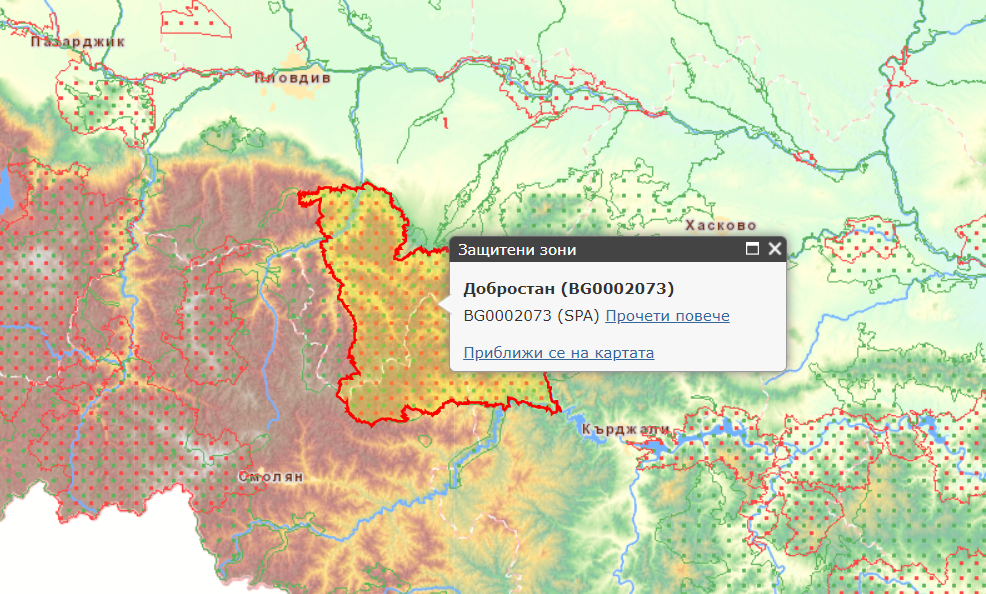
Dobrostan Protected Area - BG0002073
Protected area under Directive 79/409 / EEC for the conservation of wild birds.
Dobrostan Protected Area is located in the Western Rhodopes and is named after the mountain ridge of the same name. The territory also includes several neighboring hills - Belocherkovski rid, Krastova gora, Cherni rid and Chukata. To the north the place borders the Upper Thracian lowland, as the border passes over the town of Asenovgrad, the villages of Cherven, Dolnoslav, Oreshets, Topolovo, Novakovo, Uzunovo and Panichkovo. From the west the valleys of the Chepelarska and Manastirska rivers serve as a natural border, and from the south the Davidkovska river, the Arda river and the Kardzhali dam. The eastern border of the place is along the rivers Borovitsa and Yayladere. Dobrostan is a middle and high mountain area with a complex ridge relief, cut by river valleys. The largest area of the territory is occupied by forest habitats, mainly deciduous, coniferous and mixed forests. In the lower parts there are forests of Hairy / Quercus pubescens / and Virgil's oak / Q. virgiliana / with representatives of the Maples / Acer spp./, also forests of Silver-leaved linden / Tilia tomentosa /. On the higher parts are spread Moesian beech / Fagus moesiaca /, Gorun / Q. dalechampii / Hornbeam / Carpinus betulus / and Water Hornbeam / Ostrya carpinifolia /, as well as the largest protective massif of Black Pine / Pinus nigra / in the country. On the flat ridges and on the slopes there are open spaces - meadows, pastures with grassy vegetation with a predominance of Welsh lord / Festuca valesiaca /, Black sadina / Chrysopogon gryllus /, Common meadow / Agrostis capillaris /, etc.
Forestry and agricultural activities, tourism, etc. are carried out in the region. Intensive logging in old forests, plowing of pastures and meadows, deliberate arson, afforestation with atypical species, soil erosion, incomplete use of remote pastures, construction of small hydropower plants, off-road driving (including off-road) are only some of the real problems.
Conservation objectives
Conservation of the area of natural habitats and habitats of species and their populations subject to protection within the protected area;
Preservation of the natural state of the natural habitats and the habitats of the species subject to protection within the protected area, including the natural species composition of these habitats, characteristic species and environmental conditions;
Restoration, if necessary, of the area and natural state of priority natural habitats and habitats of species, as well as populations of species subject to protection within the protected area.
Subject of protection
According to Art. 6, para. 1, item 3 of the BDA: The subject of protection are 36 species of birds, among which are - Griffon Vulture / Gyps fulvus /, Egyptian Vulture / Neophron percnopterus /, Cross (Imperial) Eagle / Aquila heliaca /, Black Stork / Ciconia nigra / , White-tailed buzzard / Buteo rufinus /, Black woodpecker / Dryocopus martius /, etc.
According to Art. 6, para. 1, item 4 of the BDA: Black-breasted Kestrel / Falco tinnunculus /; Orco / Falco subbuteo /; Charadrius dubius; Merops apiaster; Little Hawk / Accipiter nisus /; Riparia riparia; Buteo buteo.
Within the protected area is prohibited:
Plowing pastures and turning them into arable land;
The use of pesticides in pastures and meadows;
The construction of hydroelectric power plants, except for those for which as of the date of promulgation of the order in the State Gazette the procedure has been initiated or agreed under Chapter Six of the Environmental Protection Act and / or Art. 31 of the Biodiversity Act.
×
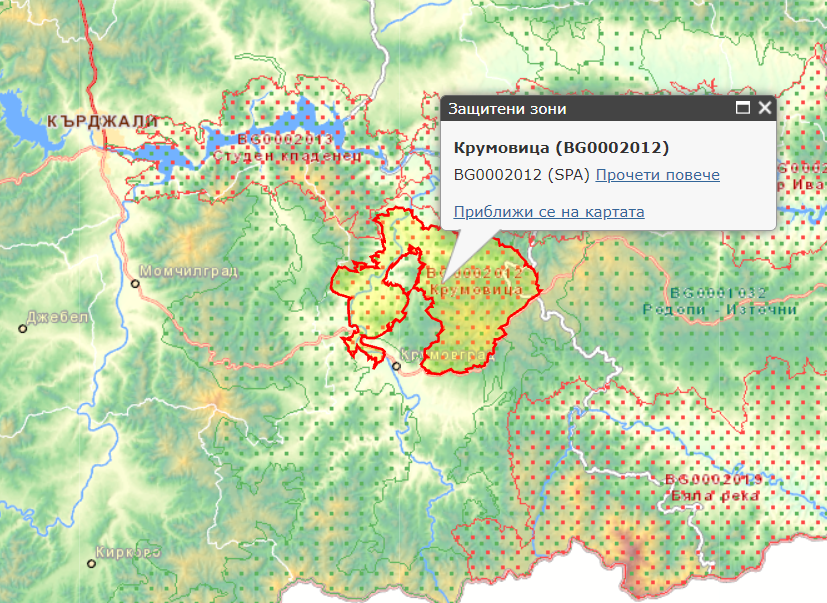
Krumovitsa Protected Area - BG0002012
Protected area under Directive 79/409 / EEC for the conservation of wild birds.
The protected area covers valleys in the middle reaches of the Krumovitsa River and the confluent river Dushun Dere with the adjacent hills and slopes of the Eastern Rhodopes. The place covers the sections of the Krumovitsa River in the area between the village of Gorna Kula and the mouth of the Dyushun Dere River, from where it reaches the land of the village of Chal to the southeast. The valley of the Krumovitsa River in the region is 300 to 1000 m wide, and in some places a significant part of it is occupied by the sandy bed of the river. The river banks are overgrown to varying degrees with coastal woody vegetation, mainly poplars / Populus spp./, willows / Salix spp./, black alder / Alnus glutinosa / and others. Among it there is an abundance of shrubs, mainly blackberries / Rubus spp./, rose hips / Rosa spp./ and others. In some sections the banks of the Krumovitsa River have steep slopes and low rocks. There are arable land in the valley extension. The valley of the Dushun Dere River is for the most part narrow and deeply carved into volcanic rocks, with many steep cliffs right next to its bed, with waterfalls and small caves. Tree vegetation along its shores is scarce, with predominantly shrubby species.
Identified threats in the area are the plowing of grasslands, extraction of aggregates, as well as the construction of wind farms, which are a threat to habitats and birds in the area.
Conservation objectives
Conservation of the area of natural habitats and habitats of species and their populations subject to protection within the protected area.
Preservation of the natural state of the natural habitats and the habitats of the species subject to protection within the protected area, including the natural species composition, characteristic species and environmental conditions of these habitats.
Restoration, if necessary, of the area and natural state of priority natural habitats and habitats of species, as well as populations of species subject to protection within the protected area.
Subject of protection
According to Art. 6, para. 1, item 3 of the BDA: The subject of protection are 32 species of birds, among which are - Large olive ridiculer / Hippolais olivetorum /; White-fronted Shrike / Lanius nubicus /; Black Vulture / Aegypius monachus /, Griffon Vulture / Gyps fulvus /; Egyptian Vulture / Neophron percnopterus /, Black Stork / Ciconia nigra /; White-tailed buzzard / Buteo rufinus /, Black woodpecker / Dryocopus martius /, etc.
According to Art. 6, para. 1, item 4 of the BDA: Black-breasted Kestrel / Falco tinnunculus /; Orco / Falco subbuteo /; Charadrius dubius; Merops apiaster; Little Hawk / Accipiter nisus /; Riparia riparia; Buteo buteo.
Within the protected area is prohibited:
Elimination of landscape characteristics (borders, single and groups of trees) in the use of agricultural land as such;
Afforestation of meadows, pastures and meadows, as well as their conversion into arable land and permanent crops;
The use of pesticides and mineral fertilizers in pastures and meadows.
×
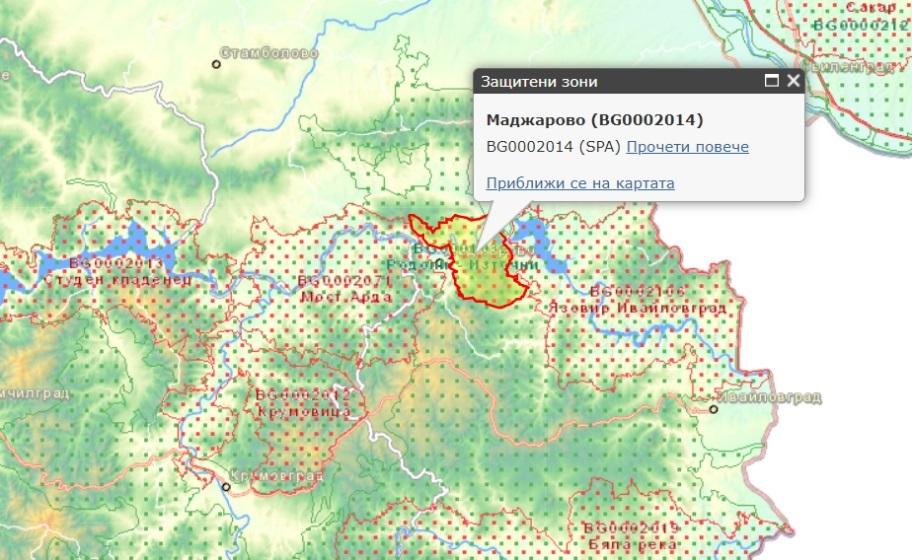
Madjarovo Protected Area - BG0002014
Protected area under Directive 79/409 / EEC for the conservation of wild birds.
Madjarovo covers part of a deep, narrow valley of the Arda River, surrounded by mountain slopes and in places up to 150 m high rock massifs. The place is located in the Eastern Rhodopes between the village of Borislavtsi and the town of Madjarovo. A significant part of the territory is occupied by rock complexes, single rocks and rocky screes. The diverse relief and the soil cover determine the development of a mosaic of woody, shrubby and herbaceous vegetation. In some places the slopes are covered with deciduous mixed forests of Quercus cerris, Quercus frainetto and hairy oak (Quercus pubescens), with Mediterranean elements such as juniper (Juniperus oxycedrus),Colutea arborescens and others. The agricultural lands are located mainly in the high parts of the valley and in the valley extension itself. The riverbed is sandy and rocky, and its banks are overgrown with willows / Salix spp./ and shrubs.
Investment projects related to gold mining are a threat to the protected area, as this can cause habitat destruction as well as soil and water pollution. Another future threat is plans to build small hydropower plants along the Arda.
Threats such as deforestation, disturbance of tourism and disturbance of low-flying military aircraft have been identified.
Conservation objectives
Conservation of the area of natural habitats and habitats of species and their populations subject to protection within the protected area;
Preservation of the natural state of the natural habitats and the habitats of the species subject to protection within the protected area, including the natural species composition of these habitats, characteristic species and environmental conditions;
Restoration, if necessary, of the area and natural state of priority natural habitats and habitats of species, as well as populations of species subject to protection within the protected area.
Subject of protection
According to Art. 6, para. 1, item 3 of the BDA: The subject of protection are 46 species of birds, among which are - Large olive ridiculer / Hippolais olivetorum /; Griffon vulture / Gyps fulvus / Black stork / Ciconia nigra / Black pitcher / Milvus migrans / etc.
According to Art. 6, para. 1, item 4 of the BDA: Coot / Fulica atra /; Medium snipe / Gallinago gallinago /; Yellow-legged Gull (Larus cachinnans); River gull / Larus ridibundus /; Great Dive / Podiceps cristatus /; Great forest waterfowl / Tringa ochropus /; Blackthorn (Falco tinnunculus), etc.
Within the protected area is prohibited:
Elimination of landscape characteristics (borders, single and groups of trees) in the use of agricultural land as such;
The use of pesticides and mineral fertilizers in pastures and meadows.
Reducing the area of riparian forests of native tree species;
Rock climbing, delta and paragliding during the nesting period from March 1 to July 31.
×
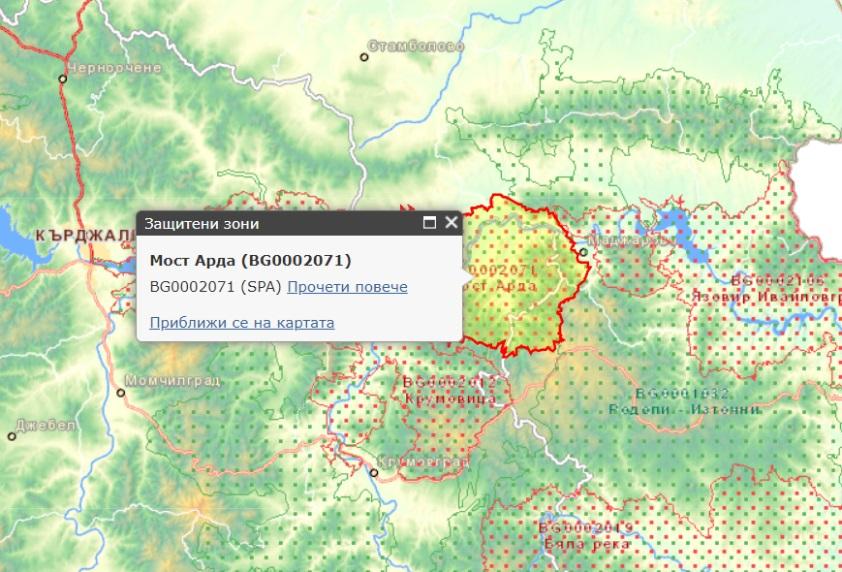
Arda Bridge Protected Area - BG0002071
Protected area under Directive 79/409 / EEC for the conservation of wild birds.
Located in Southeastern Bulgaria in the Eastern Rhodopes. It covers the valley of the river Arda from the village of Rabovo to the town of Madjarovo and the northern parts of Iraniv rid. To the north it borders the villages of Madjari, Voyvodenets, Dolno Pole, Rumelia and Gorno Pole. To the west with Pchelari, Golobradovo, Rabovo, Potochnitsa and Stari Chal. The southern border passes through Krasino, Sbor and Bubino, and the eastern border is between Bubino, Chernichino and the town of Madjarovo. The place is part of the valley of the river Arda between the dams Studen Kladenets and Ivaylovgrad, surrounded by wooded mountain slopes and rock massifs. The largest area of the site is occupied by deciduous forests and agricultural lands. Deciduous forests are represented by Quercus cerris, Blagun / Q. frainetto / and Hairy Oak / Q. pubescens / with Mediterranean elements, such as Juniperus oxycedrus, Colutea arborescens and others. Some areas are covered with hawthorn bushes / Paliurus spina-christi / and Jasmine / Jasminum fruticans / in combination with drought-loving grass formations of the Mediterranean type. In the southern parts the forests are mainly from Gorun / Q. dalechampii / in places mixed with Blagun. The agricultural lands are around the valley extension itself and on the slopes and flattened ridges. The riverbed is sandy and rocky, and its banks are overgrown with willows / Salix spp./ and shrubs.
A potential threat to both habitats and birds in the area is the construction of wind farms.
Conservation objectives
Conservation of the area of natural habitats and habitats of species and their populations subject to protection within the protected area.
Preservation of the natural state of the natural habitats and the habitats of the species subject to protection within the protected area, including the natural species composition, characteristic species and environmental conditions of these habitats.
Restoration, if necessary, of the area and natural state of priority natural habitats and habitats of species, as well as populations of species subject to protection within the protected area.
Subject of protection
According to Art. 6, para. 1, item 3 of the BDA: The subject of protection are 40 species of birds, among which are - Large olive ridiculer / Hippolais olivetorum /; White-fronted Shrike / Lanius nubicus /; Black Vulture / Aegypius monachus /; Cross (Imperial) Eagle / Aquila heliaca /; Black stork / Ciconia nigra /; Egyptian Vulture / Neophron percnopterus /; Garden bunting / Emberiza hortulana /; Sylvia nisoria, etc.
According to Art. 6, para. 1, item 4 of the BDA: Gray Heron / Ardea cinerea /; Great Hawk / Accipiter gentilis /; Little Hawk / Accipiter nisus /; Mute swan / Cygnus olor /; Merops apiaster; Buteo buteo; Charadrius dubius; Orco / Falco subbuteo /; Blackthorn (Falco tinnunculus); Gallinula chloropus; Great Cormorant / Phalacrocorax carbo / etc.
Within the protected area is prohibited:
Elimination of landscape characteristics (borders, single and groups of trees) in the use of agricultural land as such;
Afforestation of meadows, pastures and meadows, as well as their conversion into arable land and permanent crops;
The use of pesticides and mineral fertilizers in pastures and meadows.
×
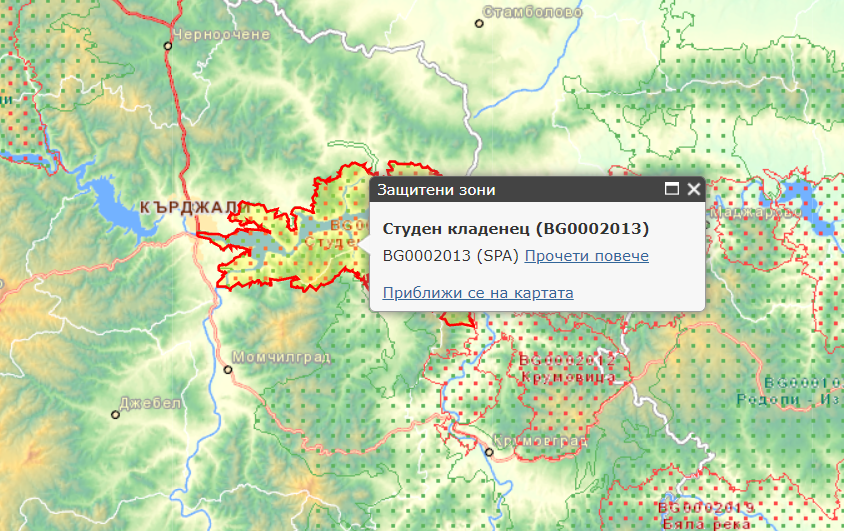
Studen Kladenets protected area - BG0002013
Protected area under Directive 79/409 / EEC for the conservation of wild birds.
A dam created in a rock gorge on the Arda River, with sheer cliffs, steep banks with sparse vegetation and adjacent mountain hills. It is located in the Eastern Rhodopes between the town of Kardzhali and the village of Studen Kladenets. About two thirds of the mountain slopes around the dam are covered with secondary deciduous mixed forests of Carpinus orientalis and Fraxinus ornus, Quercus frainetto or Quercus dalechampii with Mediterranean elements. Pure gorun forests or mixed with hornbeam (Carpinus betulus) are less common. In some places there are forests and shrubs of hornbeam and shrubs of Draca / Paliurus spina-christi / mixed with Jasmine (Jasminum fruticans), Juniper (Juniperus oxycedrus) in combination with xerothermic grass formations with Mediterranean elements such as Pamukliyka / Cus etc. A large part of the territory of the place is occupied by rock complexes, single rocks and stony screes. Scattered throughout the area are open spaces occupied by agricultural lands and meadows overgrown with xerothermic grass communities with a predominance of Bellism / Dichantium ischaemum /, Bulbous meadow / Poa bulbosa /, etc.
A potential threat to the protected area is the plowing of grasslands, the low overflight of military aircraft and the construction of wind farms.
Conservation objectives
Conservation of the area of natural habitats and habitats of species and their populations subject to protection within the protected area;
Preservation of the natural state of the natural habitats and the habitats of the species subject to protection within the protected area, including the natural species composition of these habitats, characteristic species and environmental conditions;
Restoration, if necessary, of the area and natural state of priority natural habitats and habitats of species, as well as populations of species subject to protection within the protected area.
Subject of protection
According to Art. 6, para. 1, item 3 of the BDA: The subject of protection are 60 species of birds, among which are - Large olive ridiculer / Hippolais olivetorum /; White-fronted Shrike / Lanius nubicus /; Black Vulture / Aegypius monachus /; Griffon vulture (Gyps fulvus); Black stork / Ciconia nigra /; Egyptian Vulture / Neophron percnopterus /; Bubo bubo and others
According to Art. 6, para. 1, item 4 of the BDA: Great Dive / Podiceps cristatus /; Charadrius dubius; Chlidonias leucopterus; Falco Subbuteo; Blackthorn (Falco tinnunculus); Medium snipe / Gallinago gallinago /; Gallinula chloropus; Gull (Larus canus); River gull / Larus ridibundus /; Lymnocryptes minimus; Buteo buteo, etc.
Within the protected area is prohibited:
Elimination of landscape characteristics (borders, single and groups of trees) in the use of agricultural land as such;
Afforestation of meadows, pastures and meadows, as well as their conversion into arable land and permanent crops;
The use of pesticides and mineral fertilizers in pastures and meadows;
Reducing the area of riparian forests of native tree species.
×
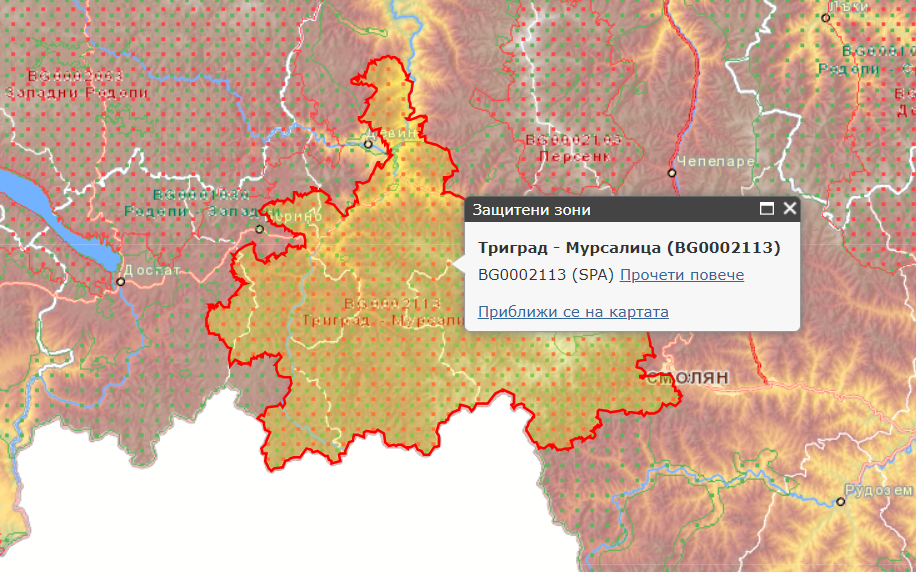
Protected area Trigrad - Mursalitsa - BG0002113
Protected area under Directive 79/409 / EEC for the conservation of wild birds.
The Trigrad-Mursalitsa Protected Area is located in the central part of the Western Rhodopes south of the town of Devin and west of the town of Smolyan. It covers the catchment area of the Vacha River (tributaries Shirokolashka, Muglenska, Buynovska, etc.), Mursalitsa ridge and part of the Videnitsa section. The southern border coincides with the state border with Greece. To the east it reaches Smolyan, to the west to the lands of the villages of Borino, Zmeitsa, Chavdar and Buynovo, and to the north it covers the valley of the river Vacha to the village of Stomanevo. The territory has a medium and high mountain character. Forests cover about 70% of the territory, with coniferous forests predominating, mainly from Spruce / Picea abies /, and in some places - from White Pine / Pinus sylvestris / and mixed coniferous forests. Some of the most valuable old forests are those of Black Pine / Pinus nigra / and Ella / Abies alba /. Small areas are occupied by deciduous forests of Moesian beech / Fagus moesiaca /, as well as mixed forests of Moesian beech and Water hornbeam / Ostrya carpinifolia /. Grassland habitats are very diverse, but the communities of Agrostis capillaris and Nardus stricta predominate.
Identified threats in the protected area are succession of permanent grasslands (pastures and meadows) and disturbance in the area of tourist areas around the large dams in the area.
Conservation objectives
Conservation of the area of natural habitats and habitats of species and their populations subject to protection within the protected area.
Preservation of the natural state of the natural habitats and the habitats of the species subject to protection within the protected area, including the natural species composition, characteristic species and environmental conditions of these habitats.
Restoration, if necessary, of the area and natural state of priority natural habitats and habitats of species, as well as populations of species subject to protection within the protected area.
Subject of protection
According to Art. 6, para. 1, item 3 of the BDA: Subject of protection are 29 species of birds, among which are - Black Stork / Ciconia nigra /; Pernis apivorus; Black woodpecker / Dryocopus martius /; Black Kite / Milvus migrans /; Eagle snake / Circaetus gallicus /; Buteo rufinus; Small bald eagle / Aquila pomarina /; Bald eagle / Aquila chrysaetos / etc.
According to Art. 6, para. 1, item 4 of the BDA: Black-breasted Kestrel / Falco tinnunculus /; Little Hawk / Accipiter nisus /; Actitis hypoleucos; Buteo buteo; Orco / Falco subbuteo /.
Within the protected area is prohibited:
Plowing pastures and turning them into arable land;
The use of pesticides in pastures and meadows;
Mowing the meadows before July 1, as well as mowing from the periphery to the center;
The opening of new gravel pits in the riverbeds and river terraces, except for those for which the procedure has been initiated in the State Gazette as of the date of promulgation of the order or have been agreed under Chapter Six of the Environmental Protection Act and / or art. 31 of the Biodiversity Act;
The construction of hydroelectric power plants, except for those for which as of the date of promulgation of the order in the State Gazette the procedure has been initiated or agreed under Chapter Six of the Environmental Protection Act and / or Art. 31 of the Biodiversity Act;
Construction of wind generators for electricity generation, except for those for which the procedure has been initiated or agreed in accordance with Chapter Six of the Environmental Protection Act as of the date of promulgation of the order in the State Gazette and / or Art. 31 of the Biodiversity Act, as well as with the exception of those for self-sufficiency of sites.
×
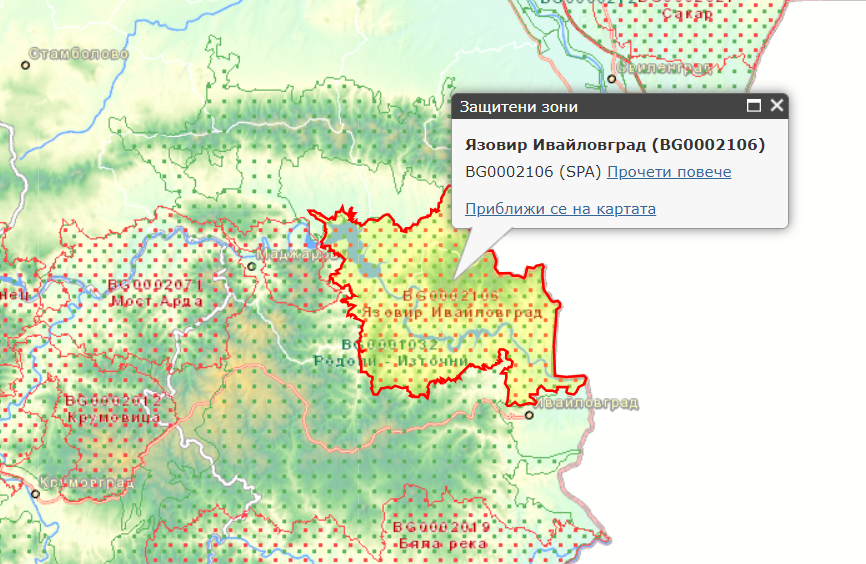
Ivaylovgrad Dam Protected Area - BG0002106
Protected area under Directive 79/409 / EEC for the conservation of wild birds.
Ivaylovgrad Dam Protected Area is located in the Eastern Rhodopes. It covers the dam of the same name in the narrow valley of the Arda River and the surrounding mountain slopes from the villages of Borislavtsi and Senoklas to the west to the state border to the east, and from the villages of Malki Voden and Dabovets to the north to Pokrovan, Huhla, Ivaylovgrad and Slaveevo to the south. Most of the site is covered by xerothermic deciduous forests. A large area is occupied by xerothermal shrubs and xeromesophytic grass formations. In some places there are separate rocks and rock walls. The arable lands are located around the dam and the leveled areas on the slopes of the mountain. In its floodplain and around it there are muddy-sandy areas and meadows. Half of the territory is occupied by mixed forests of Quercus cerris and Blagun / Q. frainetto / with Mediterranean elements.
Potential threats in the protected area include plowing pastures, tourist disturbance near the Ivaylovgrad Dam and the construction of wind farms in the area. These threats can have negative consequences for both habitats and birds.
Conservation objectives
Conservation of the area of natural habitats and habitats of species and their populations subject to protection within the protected area.
Preservation of the natural state of the natural habitats and the habitats of the species subject to protection within the protected area, including the natural species composition, characteristic species and environmental conditions of these habitats.
Restoration, if necessary, of the area and natural state of priority natural habitats and habitats of species, as well as populations of species subject to protection within the protected area.
Subject of protection
According to Art. 6, para. 1, item 3 of the BDA: Subject of protection are 50 species of birds, among which are - White-tailed sea eagle / Haliaeetus albicilla /; Pandion haliaetus; Little Eagle / Hieraaetus pennatus /; Pernis apivorus; White-fronted Shrike / Lanius nubicus /; Large olive ridiculer / Hippolais olivetorum /; Black stork / Ciconia nigra /; Great Egret / Egretta alba / etc.
According to Art. 6, para. 1, item 4 of the Biodiversity Act: Charadrius dubius; Podiceps nigricollis; Mute swan / Cygnus olor /; Fish / Anas penelope /; Gray duck / Anas strepera /; Anas crecca; Green-headed duck / Anas platyrhynchos /; Aythya ferina; Riparia riparia, etc.
Within the protected area is prohibited:
Elimination of landscape characteristics (borders, single and groups of trees) in the use of agricultural land as such;
Afforestation of meadows, pastures and meadows, as well as their conversion into arable land and permanent crops;
The use of pesticides and mineral fertilizers in pastures and meadows;
Burning coastal vegetation.
×
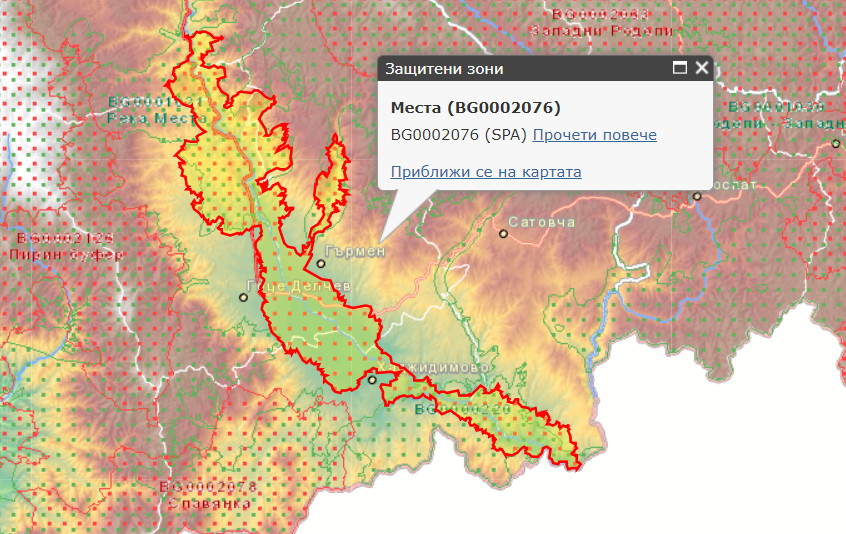
Protected area Mesta - BG0002076
Protected area under Directive 79/409 / EEC for the conservation of wild birds.
The Mesta Protected Zone covers the valley of the river of the same name from the village of Mesta in the south to the villages of Godeshevo and Beslen and the border with Greece. Its tributaries include the tributaries of the Mesta River: Tufcha near the village of Breznitsa, Kanina River near the village of Garmen, Matnitsa River near the village of Petrelik and Bistritsa River near the village of Ablanitsa. There are many mineral springs near the villages of Banya, Ognyanovo and Musomishta. A significant part of the territory is covered with pastures and agricultural lands.
The Mesta River Valley is affected by agriculture, forestry, water use and urbanization. Among the most serious impacts of agriculture are the removal of natural vegetation and the conversion of pastures and shrub habitats into arable land, as well as the widespread use of pesticides and fertilizers. Goat grazing in forests and shrubs also degrades habitat quality. Bare felling and afforestation with non-native species also have a negative impact. Direct threats to birds are caused by poaching and taking young from the nests of birds of prey, the movement of motor vehicles off-road, etc.
Conservation objectives
Conservation of the area of natural habitats and habitats of species and their populations subject to protection within the protected area.
Preservation of the natural state of the natural habitats and the habitats of the species subject to protection within the protected area, including the natural species composition, characteristic species and environmental conditions of these habitats.
Restoration, if necessary, of the area and natural state of priority natural habitats and habitats of species, as well as populations of species subject to protection within the protected area.
Subject of protection
According to Art. 6, para. 1, item 3 of the BDA: 44 species of birds are subject to protection, the most typical of which are - White-tailed buzzard / Buteo rufinus /; Pernis apivorus; Great Spotted Eagle / Aquila clanga /; Black stork / Ciconia nigra /; Great Egret / Egretta alba /; Small water bull / Ixobrychus minutus /, etc.
According to Art. 6, para. 1, item 4 of the BDA: Great Hawk / Accipiter gentilis /; Great Cormorant / Phalacrocorax carbo /; Merops apiaster; Riparia riparia; Blackthorn (Falco tinnunculus); Tachybaptus ruficollis, etc.
Within the protected area is prohibited:
Afforestation of pastures and measures, as well as their conversion into arable land and permanent crops;
The use of pesticides and mineral fertilizers in pastures;
The construction of hydroelectric power plants, except for those for which as of the date of promulgation of the order in the State Gazette the procedure has been initiated or agreed under Chapter Six of the Environmental Protection Act and / or Art. 31 of the Biodiversity Act;
Construction of wind generators for electricity generation, except for those for which the procedure has been initiated or agreed in accordance with Chapter Six of the Environmental Protection Act as of the date of promulgation of the order in the State Gazette and / or Art. 31 of the Biodiversity Act, as well as with the exception of those for self-sufficiency of sites.
×
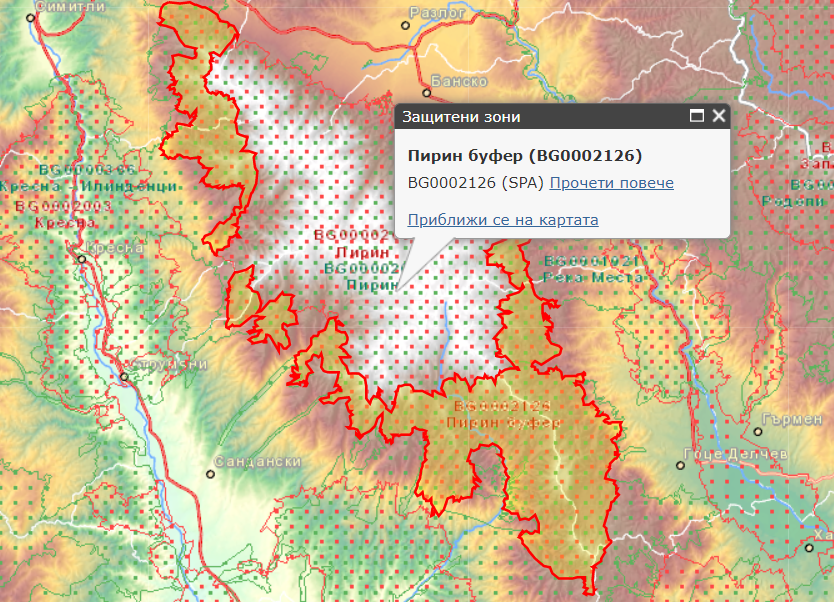
Pirin Buffer Protected Area - BG0002126
Protected area under Directive 79/409 / EEC for the conservation of wild birds.
Pirin Buffer Protected Area is located in southwestern Bulgaria between the valley of the Struma River in the west and the Mesta River in the east. It covers the higher part of the mountain of the same name. To the north the Predel saddle separates it from Rila, and to the south its territory extends to the Paril saddle. Its territory completely covers the Pirin National Park. Morphographically, the mountain is divided into three parts: northern, middle and southern. The main ridge is northwest - southeast and is the main watershed between the rivers Struma and Mesta. The mountain is characterized by pointed peaks and steep and steep slopes. The oldest rock complexes in it are metamorphic granite gneisses, crystalline shales and marbles. About 62% of the area is occupied by Paleozoic and Mesozoic granites and granite-like rocks. The limestone part, including marbled limestone, is the richest part of monoecious plant species. On the territory of Pirin the soils are brown forest and mountain dark-colored forest, smaller areas are occupied by mountain-meadow and humus-carbonate. Pirin Mountain is covered mainly with forests (71%) and alpine meadows and open spaces (10%). Grassland habitats in the alpine zone are represented by communities of Sesleria coerulans, Dryias octopelata and Salix reticulata on marble base and Carex curvula, Agis agrost fescue / Festuca airoides /, etc. on silicate terrains, and both types of communities include a wide variety of plant species. The subalpine belt is also fully developed with widespread formations of Juniper (Pinus mugo), Juniperus sibirica, Chamaecitisus absinthoides, Vaccinium uliginosum, Festuca penzes. valida / et al. The coniferous belt is represented by communities of Spruce / Picea abies /, White Fir / Pinus peuce / and White Pine / Pinus sylvestris / on silicate terrains and by formations of Black Fir / P. heldreichii / and Black Pine / Pinus nigra / on marble terrains. The shrubs in the coniferous belt are represented by Juniperus siberica, the Balkan chamaecytisus absinthoides and the blueberry Vaccinium myrtillus, and the grass habitats are represented by black fescue (Festuca nig) communities. At an altitude of 900 - 1600 m. Fagus sylvatica predominates. At lower altitudes, the deciduous forests of Gorun / Quercus dalechampii /, Common hornbeam / Carpinus betulus / and Moesian beech / Fagus moesiaca / predominate.
The protected zone falls within the lands of the village of Dobrinishte, the village of Kremen, the village of Obidim, the municipality of Bansko, the municipality of Blagoevgrad, the village of Luzhnitsa, the village of Sredna, the municipality of Gotse Delchev, the district of Blagoevgrad, the village of Vlahi, the village of Oshtava, Stara Kresna village, Kresna municipality, Blagoevgrad district, Belyovo village, Bozhdovo village, Vihren village, Golem Tsalim village, Gorna Sushitsa village, Doleni village, Kashina village, Kovachevo village, Lilyanov village, Pirin, village of Ploski, village of Sugarevo, village of Hrasna, village of Chereshnitsa, municipality of Sandanski, district of Blagoevgrad, village of Teshovo, municipality of Hadjidimovo, district of Blagoevgrad, village of Brezhani, village of Gradevo, village of Senokos, town of Simitli , Simitli municipality, Blagoevgrad district, and the village of Ilindentsi, Strumyani municipality, Blagoevgrad district.
Conservation objectives
Conservation of the area of natural habitats and habitats of species and their populations subject to protection within the protected area.
Preservation of the natural state of the natural habitats and the habitats of the species subject to protection within the protected area, including the natural species composition, characteristic species and environmental conditions of these habitats.
Restoration, if necessary, of the area and natural state of priority natural habitats and habitats of species, as well as populations of species subject to protection within the protected area.
Subject of protection
According to Art. 6, para. 1, item 3 of the BDA: 36 species of birds are subject to protection, among which are: White-tailed buzzard / Buteo rufinus /; Great Egret / Egretta alba /; Black stork / Ciconia nigra /; White stork / Ciconia ciconia /; Pernis apivorus; Egyptian Vulture / Neophron percnopterus /; Griffon vulture (Gyps fulvus); Small bald eagle / Aquila pomarina /; Bubo bubo and others
According to Art. 6, para. 1, item 4 of the BDA: Little Hawk / Accipiter nisus /; Merops apiaster; Charadrius dubius; Gallinula chloropus; Orco / Falco subbuteo /; Buteo buteo; Green-headed duck / Anas plathyrhynchos /; Anas crecca; Falco tinnunculus.
Within the protected area is prohibited:
The use of non-selective pests in forests and agriculture;
The use of pesticides and mineral fertilizers in pastures and meadows;
Afforestation of meadows, pastures and meadows, as well as their conversion into arable land and permanent crops.
×
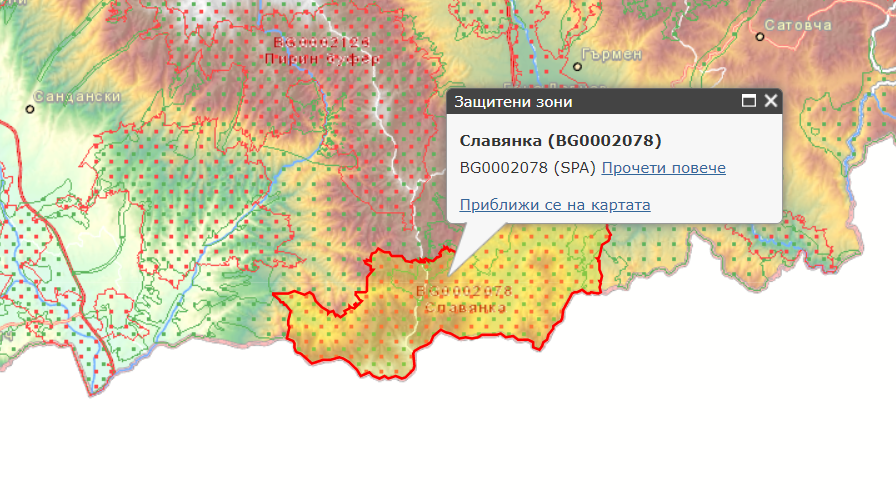
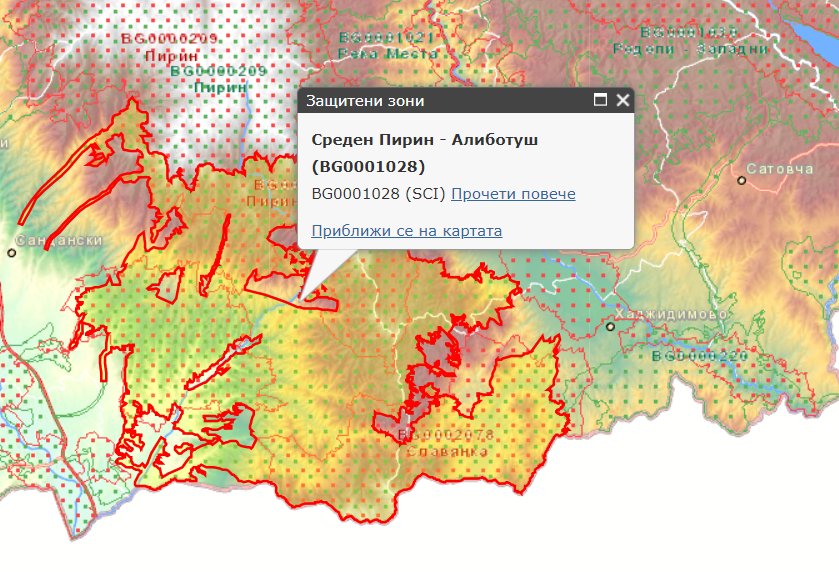
Защитена зона Славянка - BG0002078
Protected area under Directive 79/409 / EEC for the conservation of wild birds.
The protected area is located in southwestern Bulgaria, south of Pirin. The borders follow the orographic borders of the mountain of the same name, covering part of the South Pirin north of the Goleshevska River and part of the western slopes of the Strgach Mountain. The northern border passes south of the villages of Sadovo, Teshovo and Goleshovo, to the east it coincides with the road from Sadovo to the Ilinden border checkpoint, and to the west it reaches the village of Petrovo. To the south it stretches to the state border with Greece. Slavyanka is built of Proterozoic metamorphosed limestone and marble, which is why the terrain of the mountain is typically karst. Due to this, it is poor in surface water, but at the foot of it there are numerous karst springs. This feature in its geological structure, geographical location and climate in the region create conditions for diverse nature. In Slavyanka are observed almost all plant belts established in Bulgaria. At the foot of the mountain the xerothermic oak belt is composed mainly of secondary forests, as well as Carpinus orientalis. Above them stretch the forests of Moesian beech / Fagus moesiaca / and Hornbeam / Ostrya carpinifolia /, as well as extensive forests of Black Pine / Pinus nigra /. There are also communities of Tsar Boris's fir / Abies borisii-regis /. In the coniferous belt of the mountain there are forests of Black fir / Pinus heldreichii /, typical of the limestone mountains in the southern and western parts of the Balkan Peninsula. Above the upper border of the forest are formed mostly subalpine shrubs and grass communities, also typical of these mountains. Evergreen plants are also found. There is a large number of Mediterranean and sub-Mediterranean species of invertebrates and vertebrates.
The protected zone falls within the lands of the villages of Ilinden, Lucky, Lyalevo, Nova Lovcha, Paril, Sadovo, Teshevo, Gaitaninovo, Hadjidimovo municipality, Blagoevgrad district, Belovo, Goleshevo and Petrovo villages, Sandanski municipality, Blagoevgrad district.
Conservation objectives
Conservation of the area of natural habitats and habitats of species and their populations subject to protection within the protected area.
Preservation of the natural state of the natural habitats and the habitats of the species subject to protection within the protected area, including the natural species composition, characteristic species and environmental conditions of these habitats.
Restoration, if necessary, of the area and natural state of priority natural habitats and habitats of species, as well as populations of species subject to protection within the protected area.
Subject of protection
According to Art. 6, para. 1, item 3 of the BDA: 37 species of birds are subject to protection, some of which are - Owl / Bubo bubo /; Caprimulgus europaeus; Small bald eagle / Aquila pomarina /; Little Eagle / Hieraaetus pennatus /; Griffon vulture (Gyps fulvus); Eagle snake / Circaetus gallicus /; Buteo rufinus; Pernis apivorus and others
According to Art. 6, para. 1, item 4 of the BDA: Black-breasted Kestrel / Falco tinnunculus /; Merops apiaster; Great Hawk / Accipiter gentilis /; Little Hawk / Accipiter nisus /; Orco / Falco subbuteo /; Buteo buteo.
Within the protected area is prohibited:
Elimination of landscape features (borders, single and groups of trees) in the use of agricultural land as such;
Afforestation of meadows, pastures and meadows, as well as their conversion into arable land and permanent crops;
The use of pesticides and mineral fertilizers in pastures and meadows;
Opencast mining;
Construction of facilities for electricity generation by wind power.
×
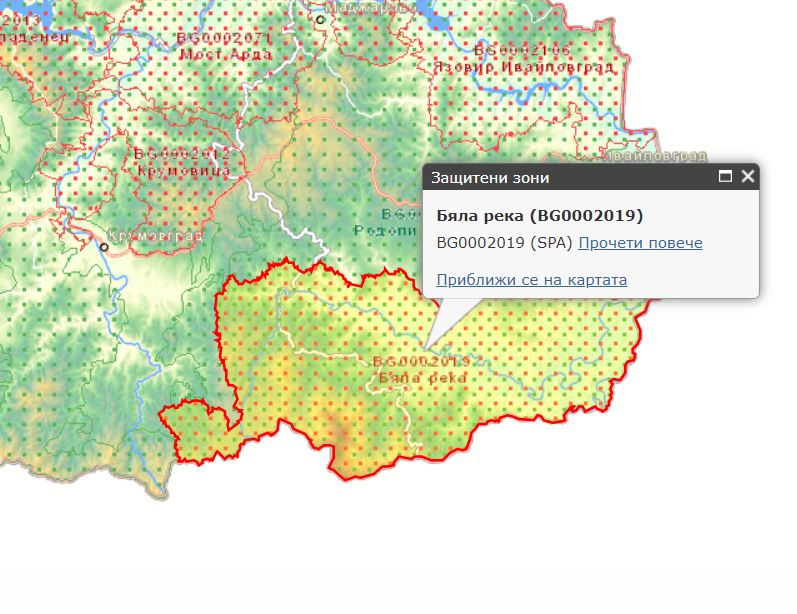
Byala Reka Protected Area - BG0002019
Protected area under Directive 79/409 / EEC for the conservation of wild birds.
The protected area falls in the Eastern Rhodopes. It includes the valley of the White River and the surrounding hills and slopes. The vegetation in the area is diverse and strongly influenced by the Mediterranean. In the higher parts there are forests of Moesian beech / Fagus sylvatica L. subsp. moesiaca / and forests of Gorun / Quercus dalechampii /. The mixed oak forests of Gorun, Quercus virgiliana, Quercus frainetto and Quercus pubescens are also more widespread, in places mixed with Carpinus orientalis. Well-represented in the area are Mediterranean-type shrub communities with significant species diversity, with a predominance of Phyllirea latifolia, Juniperus oxycedrus, with the participation of Paliurus spina-christi, Fraxinus ornus. The riverbed is sandy-stony. The shores are overgrown with willows / Salix spp./, Eastern plane tree / Platanus orientalis / and shrubs.
Threats have been identified in the protected area, such as deforestation due to the requirements of the Rural Development Program, forest fires, deforestation.
For forest habitats, threats are related to afforestation with non-native tree species, as well as illegal logging, especially along rivers. A potential threat to both habitats and birds in the area is the construction of wind farms. These, already built on Greek territory near the Bulgarian border, hinder the movement of birds and cause fragmentation of vulture habitats from the two major colonies in the region - the Arda Valley in Bulgaria and the one in Dadia, Greece. A potential threat is also investment projects related to the extraction of minerals, which can cause further destruction and fragmentation of habitats, as well as soil and water pollution.
Conservation objectives
Conservation of the area of natural habitats and habitats of species and their populations subject to protection within the protected area.
Preservation of the natural state of the natural habitats and the habitats of the species subject to protection within the protected area, including the natural species composition, characteristic species and environmental conditions of these habitats.
Restoration, if necessary, of the area and natural state of priority natural habitats and habitats of species, as well as populations of species subject to protection within the protected area.
Subject of protection
According to Art. 6, para. 1, item 3 of the BDA: The subject of protection are 43 species of birds, some of which are - Large olive ridiculer / Hippolais olivetorum /; White-fronted Shrike / Lanius nubicus /; Black Vulture / Aegypius monachus /; Black stork / Ciconia nigra /; Pernis apivorus; Caprimulgus europaeus; Eagle snake / Circaetus gallicus /; Little Eagle / Hieraaetus pennatus / etc.
According to Art. 6, para. 1, item 4 of the BDA: Yellow-legged Gull / Larus cachinnans /; Buteo buteo; River gull / Larus ridibundus /; Great forest waterfowl / Tringa ochropus /; Common nun / Vanellus vanellus /; Great Cormorant / Phalacrocorax carbo /; Gallinula chloropus; Tachybaptus ruficollis; Blackthorn (Falco tinnunculus); Charadrius dubius, etc.
Within the protected area is prohibited:
Elimination of landscape features (borders, single and groups of trees) in the use of agricultural land as such;
Afforestation of meadows, pastures, as well as their conversion into arable land and permanent crops;
Replacement of riparian forests of native tree species with non-native ones at a distance of up to 50 m from the boundaries of water bodies;
Carrying out felling in poplar crops without subsequent afforestation;
Burning reeds and coastal vegetation;
Mowing reeds from March 1st to August 15th;
Removal of aquatic and soil-loving vegetation in the canals, shores and dikes of the pools during the nesting period from March 1st to July 31st.
×
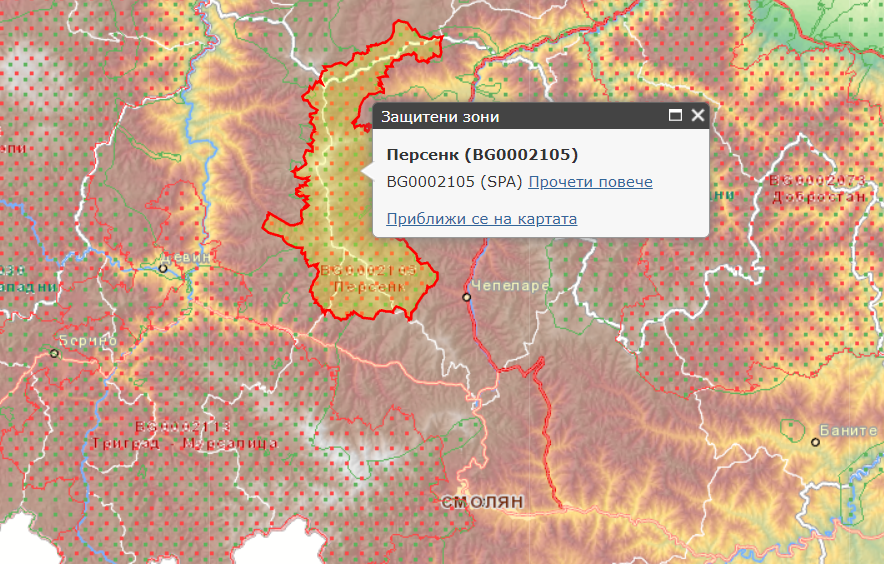
Persenk Protected Area - BG0002105
Protected area under Directive 79/409 / EEC for the conservation of wild birds.
The protected zone falls within the lands of the villages of Lyaskovo, Churekovo, Breze, Mihalkovo, Devin municipality, Smolyan district, Zornitsa village, Malevo village, Zabardo village, Orehovo village, Chepelare town , Smolyan municipality, Smolyan district, Sitovo village and Lilkovo village, Rodopi municipality, Plovdiv district.
Conservation objectives
Conservation of the area of natural habitats and habitats of species and their populations subject to protection within the protected area.
Preservation of the natural state of the natural habitats and the habitats of the species subject to protection within the protected area, including the natural species composition, characteristic species and environmental conditions of these habitats.
Restoration, if necessary, of the area and natural state of priority natural habitats and habitats of species, as well as populations of species subject to protection within the protected area.
Subject of protection
According to Art. 6, para. 1, item 3 of the BDA: 18 species of birds are subject to protection, some of which are - Pernis apivorus; Eagle snake / Circaetus gallicus /; Black woodpecker / Dryocopus martius /, etc.
According to Art. 6, para. 1, item 4 of the BDA: Great Hawk / Accipiter gentilis /; Little Hawk / Accipiter nisus /; Buteo buteo; Orco / Falco subbuteo /; Falco tinnunculus.
Within the protected area is prohibited:
Elimination of landscape features (borders, single and groups of trees) in the use of agricultural land as such;
Afforestation of meadows, pastures and meadows, as well as their conversion into arable land and permanent crops;
The use of pesticides and mineral fertilizers in pastures and meadows;
Reducing the area of riparian forests of native tree species.
×
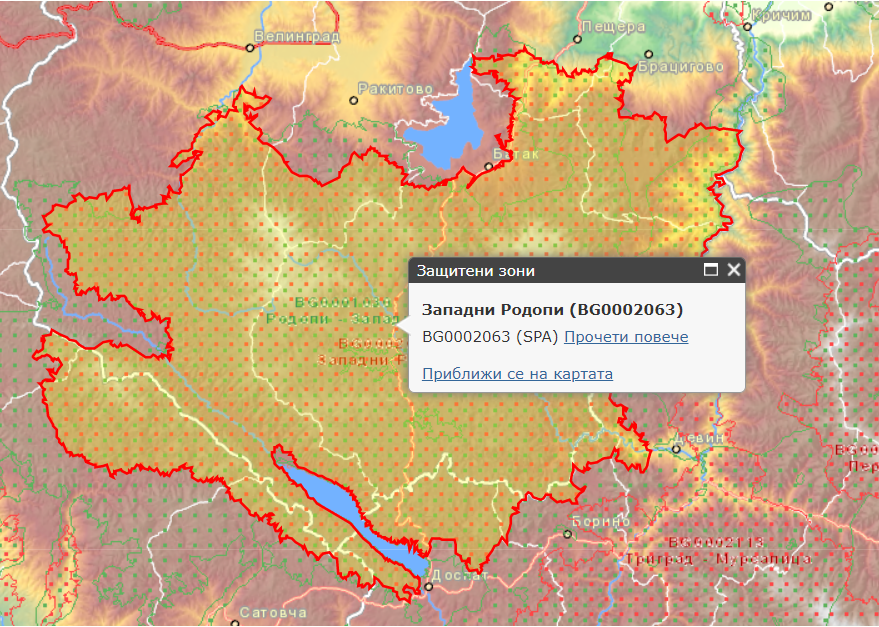
Protected area of the Western Rhodopes - BG0002063
Protected area under Directive 79/409 / EEC for the conservation of wild birds.
The Western Rhodopes Protected Area covers the higher western part of the mountain of the same name with the most representative pseudo-boreal coniferous forests, unique in Europe. The northern border follows the line Velingrad - Rakitovo - Batak - Peshtera. The largest area is occupied by forests of Scots pine / Pinus sylvestris /, followed by Spruce / Picea abies /. Smaller in area are the spruce / Abies alba / and beech / Fagus sylvatica / forests. There are also forests of Black Pine / Pinus nigra / and coppice forests of Gorun / Quercus dalechampii /, Aspen / Populus tremula / and Winter Oak / Q. dalechampii /. About 10% of the territory is occupied by open spaces - pastures and meadows with a predominance of common meadow / Agrostis capillaris /, Kartl / Nardus stricta /, etc., as well as shrub communities. There are 3 large dams on the territory - Dospat, Shiroka Polyana and Golyam Beglik, as well as hundreds of small peat bogs.
Threats such as succession of permanent grasslands (pastures and meadows) and disturbance in the area of tourist areas around the large dams in the area have been identified in the protected area.
Conservation objectives
Conservation of the area of natural habitats and habitats of species and their populations subject to protection within the protected area.
Preservation of the natural state of the natural habitats and the habitats of the species subject to protection within the protected area, including the natural species composition, characteristic species and environmental conditions of these habitats.
Restoration, if necessary, of the area and natural state of priority natural habitats and habitats of species, as well as populations of species subject to protection within the protected area.
Subject of protection
According to Art. 6, para. 1, item 3 of the BDA: 24 species of birds are subject to protection, some of which are - Caprimulgus europaeus; Pernis apivorus; White stork / Ciconia ciconia /; Black stork / Ciconia nigra /; Bubo bubo and others
According to Art. 6, para. 1, item 4 of the BDA: Little Hawk / Accipiter nisus /; Buteo buteo; Blackthorn (Falco tinnunculus); Orco / Falco subbuteo /; Merops apiaster.
Within the boundaries of the protected area it is prohibited:
Elimination of landscape features (borders, single and groups of trees) in the use of agricultural land as such;
Afforestation of meadows, pastures and meadows, as well as their conversion into arable land and permanent crops;
The use of pesticides and mineral fertilizers in pastures and meadows.
×
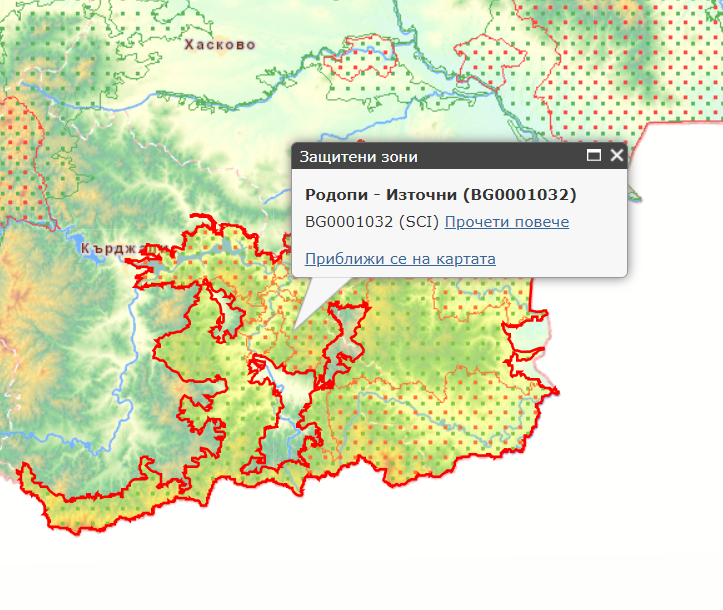
Rhodope-Eastern Protected Area - BG0001032
Protected area under Directive 92/43 / EEC for the protection of natural habitats and of wild fauna and flora.
The protected area covers most of the Eastern Rhodopes. It includes the two highest ridges of the Eastern Rhodopes - the Gyumyurjinski Snezhnik ridge with a height of 1,463 m above sea level and the Maglenik ridge with a height of 1,266 m.
Conservation objectives
Conservation of the area of natural habitats and habitats of species and their populations subject to protection within the protected area.
Preservation of the natural state of the natural habitats and the habitats of the species subject to protection within the protected area, including the natural species composition, characteristic species and environmental conditions of these habitats.
Restoration, if necessary, of the area and natural state of priority natural habitats and habitats of species, as well as populations of species subject to protection within the protected area.
Fish - Balkan pinch / Sabanejewia aurata /; Rasper / Aspius aspius / and others
Amphibians and reptiles - Testudo graeca; Testudo hermanni; Southern Crested Newt (Triturus karelinii); Elaphe quatuorlineata, etc.
Mammals, without bats - Brown bear / Ursus arctos /; European wolf / Canis lupus /; Otter / Lutra lutra / etc.
Bats - Rhinolophus ferrumequinum/ Rhinolophus hipposideros /; Myotis myotis, etc.
Plant species - Himantoglossum caprinum.
Natural habitats - 3260 Plain or mountain rivers with vegetation of Ranunculion fluitantis and Callitricho-Batrachion; 5210 Shrubs with Juniperus spp .; 6510 Lowland hay meadows; 91W0 Moesian beech forests, etc.
Within the protected area is prohibited:
Car racing off-road and designated off-road races;
Movement of motorcycles, ATVs, UTVs and buggies off existing roads in non-urban areas; the prohibition does not apply to the routes for the movement of the listed motor vehicles determined on the basis of a normative act, as well as in case of disasters, emergencies and for carrying out fire-fighting, emergency, control and rescue activities;
Changing the way of permanent use, plowing, afforestation and conversion into permanent crops of meadows, pastures and measures for the use of agricultural land as such;
Plowing and afforestation of meadows, barren lands and other unforested forest territories within the boundaries of non-mountain natural habitats under item 2.1 except in cases of proven need for protection against erosion and floods, as well as in cases of implementation of eligible plans, programs, projects or investment proposals approved in accordance with environmental legislation;
Elimination of landscape features (borders, living single and groups of trees, traditional strips occupied by shrubbery among arable land, protective forest belts, stone fences and hedges) in the use of agricultural land as such except in cases of removal of invasive alien species of trees and shrubs;
Use of fertilizers, soil improvers, biologically active substances, nutrient substrates and plant protection products that do not meet the requirements of the Plant Protection Act;
Use of mineral fertilizers in meadows, pastures, meadows and abandoned arable lands, as well as plant protection products and biocides of professional category of use in these areas except in calamity, epiphytosis, epizootic, epidemic or in the application of selective methods to combat invasive alien species;
Use of organic sludge from industrial and other waters and household waste for introduction into agricultural lands without permission from the specialized bodies of the Ministry of Agriculture, Food and Forestry and when the concentration of heavy metals, metalloids and persistent organic pollutants in sludge exceeds background concentrations according to Annex № 1 of Ordinance № 3 of 2008 on the norms for permissible content of harmful substances in soils (SG, issue 71 of 2008);
Use of irrigation water that contains harmful substances and waste above the permissible norms;
Burning of stubble, syllables, roadside strips and areas with dry and moisture-loving vegetation;
Burning fires, landscaping, electrification, economic and sports activities in undeveloped caves and their entrances, as well as breaking, damaging, collecting or moving rock and cave formations, blocking the entrances or their individual galleries in a way , preventing the passage of the species of bats subject to protection under item 2.2.1;
Conducting speleological research during the breeding season of bats - March 1 to June 30;
Extraction of wood and biomass in old age forests, except in cases of damage of more than 50% of the area of the respective old age forest due to natural disasters and calamities; in the old-age forests through which existing forest roads and other infrastructure sites pass, if proven necessary, felling of single dry, damaged, endangered or obstructing the safe movement of people and vehicles or the normal functioning of infrastructure sites trees is allowed. ;
Grazing of domestic animals in forest areas, which are designated for forests in the old age phase.
×
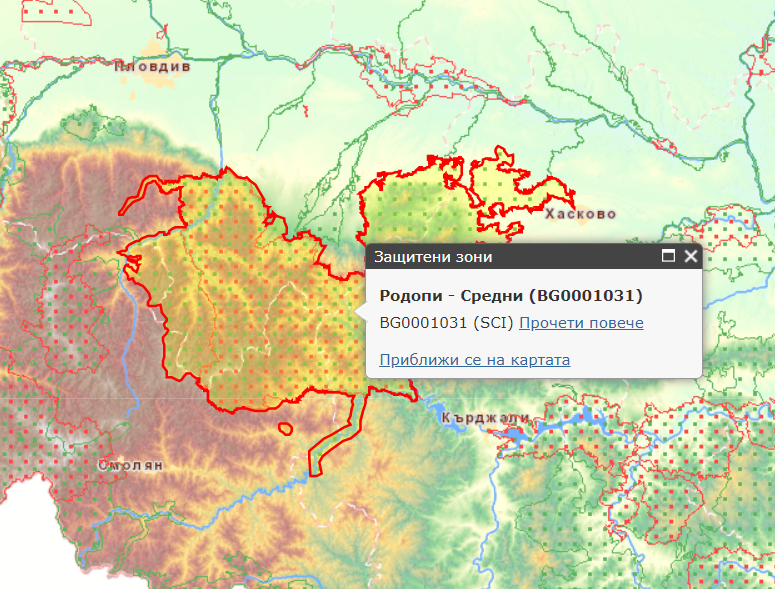
Protected area Rhodopes - Sredni - BG0001031
Protected area under Directive 92/43 / EEC for the protection of natural habitats and of wild fauna and flora.
The protected zone covers the lands of the village of Kutela, the village of Momchilovtsi, the village of Petkovo and the village of Slaveyno.
Conservation objectives
Conservation of the area of natural habitats and habitats of species and their populations subject to protection within the protected area.
Preservation of the natural state of the natural habitats and the habitats of the species subject to protection within the protected area, including the natural species composition, characteristic species and environmental conditions of these habitats.
Restoration, if necessary, of the area and natural state of priority natural habitats and habitats of species, as well as populations of species subject to protection within the protected area.
Natural habitats - 6510 Lowland hay meadows; 6520 Mountain hay meadows; 91W0 Moesian beech forests; 7140 Transitional marshes and floating peat bogs, etc.
Within the protected area is prohibited:
Car racing off-road and designated off-road races;
Movement of motorcycles, ATVs, UTVs and buggies off existing roads in non-urban areas; the prohibition does not apply to the routes for the movement of the listed motor vehicles determined on the basis of a normative act, as well as in case of disasters, emergencies and for carrying out fire-fighting, emergency, control and rescue activities;
Changing the way of permanent use, plowing, afforestation and conversion into permanent crops of meadows, pastures and measures for the use of agricultural land as such;
Plowing and afforestation of meadows, barren lands and other unforested forest territories within the boundaries of non-mountain natural habitats under item 2.1 except in cases of proven need for protection against erosion and floods, as well as in cases of implementation of eligible plans, programs, projects or investment proposals approved in accordance with environmental legislation;
Elimination of landscape features (borders, living single and group trees, traditional strips of shrubland among arable land, protective forest belts, stone fences and hedges) in the use of agricultural land as such, except in cases the removal of invasive alien species of trees and shrubs;
Use of fertilizers, soil improvers, biologically active substances, nutrient substrates and plant protection products that do not meet the requirements of the Plant Protection Act;
Use of mineral fertilizers in meadows, pastures, meadows and abandoned arable lands, as well as plant protection products and biocides of professional category of use in these areas, except for calamity, epiphytosis, epizootic, epidemic or in the application of lecture methods for combating invasive alien species;
Use of organic sludge from industrial and other waters and household waste for introduction into agricultural lands without permission from the specialized bodies of the Ministry of Agriculture, Food and Forestry and when the concentration of heavy metals, metalloids and persistent organic pollutants in sludge exceeds background concentrations according to Annex № 1 of Ordinance № 3 of 2008 on the norms for permissible content of harmful substances in soils (SG, issue 71 of 2008);
Use of irrigation water that contains harmful substances and waste above the permissible norms;
Burning of stubble, syllables, roadside strips and areas with dry and moisture-loving vegetation;
Burning fires, landscaping, electrification, economic and sports activities in undeveloped caves and their entrances, as well as breaking, damaging, collecting or moving rock and cave formations, blocking the entrances or their individual galleries in a way , preventing the passage of the species of bats subject to protection under item 2.2.1;
Conducting speleological research during the breeding season of bats - from March 1 to June 30;
Grazing of domestic animals in forest areas, which are designated for forests in the old age phase;
Extraction of wood and biomass in old age forests, except in cases of damage of more than 50% of the area of the respective old age forest due to natural disasters and calamities; in the old-age forests through which existing forest roads and other infrastructure sites pass, if proven necessary, felling of single dry, damaged, endangered or obstructing the safe movement of people and vehicles or the normal functioning of infrastructure sites trees is allowed. ;
Construction of new roads of second and higher class without ensuring the construction of appropriate green infrastructure for the passage of bears and other animals.
×
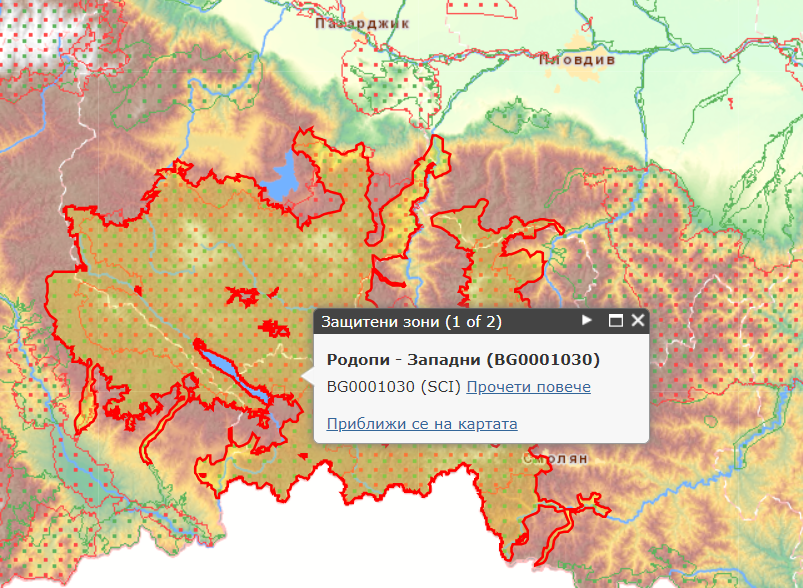
Protected area Rhodopes - Western - BG000103
Protected area under Directive 92/43 / EEC for the protection of natural habitats and of wild fauna and flora.
Conservation objectives
Conservation of the area of natural habitats and habitats of species and their populations subject to protection within the protected area.
Preservation of the natural state of the natural habitats and the habitats of the species subject to protection within the protected area, including the natural species composition, characteristic species and environmental conditions of these habitats.
Restoration, if necessary, of the area and natural state of priority natural habitats and habitats of species, as well as populations of species subject to protection within the protected area.
Subject of protection
Invertebrates - Pearl mussel / Unio crassus /; Cerambyx cerdo; Stag beetle / Lucanus cervus /; Beech felling / Morimus funereus /; Rosalia alpina; Hand cancer / Austropotamobius torrentium / etc.
Fish - Barbus plebejus; European bitters / Rhodeus sericeus amarus /.
Amphibians and reptiles - Testudo graeca; Testudo hermanni; Southern Crested Newt (Triturus karelinii), etc.
Mammals without bats - European wolf / Canis lupus /; Otter / Lutra lutra /; Brown bear / Ursus arctos /; Wild goat / Rupicapra rupicapra balcanica /; Spermophilus citellus and others
Plant species - Red viper / Echium russicum /; Gladiolus palustris, etc.
Natural habitats - 3260 Plain or mountain rivers with vegetation of Ranunculion fluitantis and Callitricho-Batrachion; 6520 Mountain hay meadows; 91W0 Moesian beech forests; 5130 Communities of Juniperus communis on limestone, etc.
Within the protected area is prohibited:
Car racing off-road and designated off-road races;
Movement of motorcycles, ATVs, UTVs and buggies off existing roads in non-urban areas; the prohibition does not apply to the routes for the movement of the listed motor vehicles determined on the basis of a normative act, as well as in case of disasters, emergencies and for carrying out fire-fighting, emergency, control and rescue activities;
Changing the way of permanent use, plowing, afforestation and conversion into permanent crops of meadows, pastures and measures for the use of agricultural land as such;
Plowing and afforestation of meadows, barren lands and other unforested forest territories within the boundaries of non-mountain natural habitats under item 2.1 except in cases of proven need for protection against erosion and floods, as well as in cases of implementation of eligible plans, programs, projects or investment proposals approved in accordance with environmental legislation;
Elimination of landscape features (borders, living single and groups of trees, traditional strips occupied by shrubbery among arable land, protective forest belts, stone fences and hedges) in the use of agricultural land as such except in cases the removal of invasive alien species of trees and shrubs;
Use of fertilizers, soil improvers, biologically active substances, nutrient substrates and plant protection products that do not meet the requirements of the Plant Protection Act;
Use of mineral fertilizers in meadows, pastures, meadows and abandoned arable lands, as well as plant protection products and biocides of professional category of use in these areas, except for calamity, epiphytosis, epizootic, epidemic or in the application of selective methods for combating invasive alien species;
Use of organic sludge from industrial and other waters and household waste for introduction into agricultural lands without permission from the specialized bodies of the Ministry of Agriculture, Food and Forestry and when the concentration of heavy metals, metalloids and persistent organic pollutants in sludge exceeds background concentrations according to Annex № 1 of Ordinance № 3 of 2008 on the norms for permissible content of harmful substances in soils (SG, issue 71 of 2008);
Use of irrigation water that contains harmful substances and waste above the permissible norms;
Burning of stubble, syllables, roadside strips and areas with dry and moisture-loving vegetation;
Burning fires, landscaping, electrification, economic and sports activities in undeveloped caves and their entrances, as well as breaking, damaging, collecting or moving rock and cave formations, blocking the entrances or their individual galleries in a way , preventing the passage of the species of bats subject to protection under item 2.2.1;
Conducting speleological research during the breeding season of bats - from March 1 to June 30;
Extraction of wood and biomass in old age forests, except in cases of damage of more than 50% of the area of the respective old age forest due to natural disasters and calamities; in the old-age forests through which existing forest roads and other infrastructure sites pass, if proven necessary, felling of single dry, damaged, endangered or obstructing the safe movement of people and vehicles or the normal functioning of infrastructure sites trees is allowed. ;
Grazing of domestic animals in forest areas, which are designated for forests in the old age phase.
×
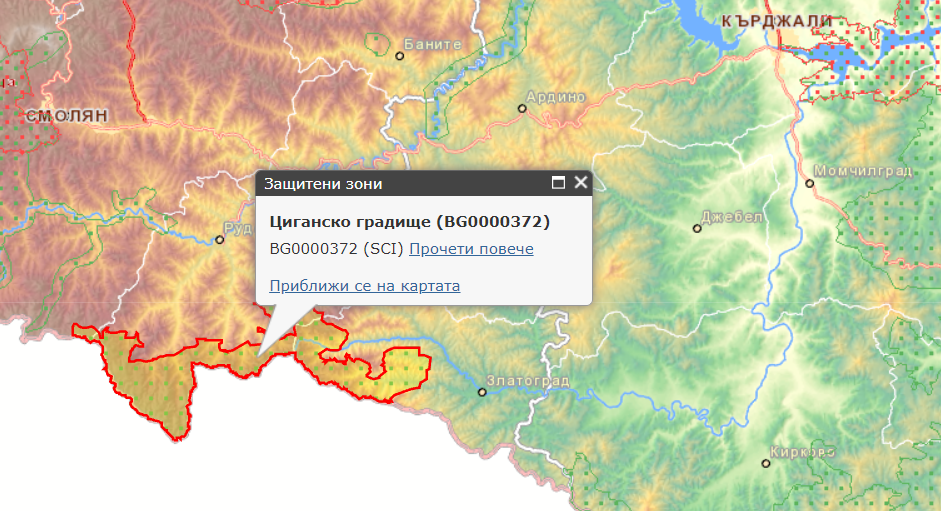
Protected area Tsigansko Gradishte - BG0000372
Protected area under Directive 92/43 / EEC for the protection of natural habitats and of wild fauna and flora.
Conservation objectives
Conservation of the area of natural habitats and habitats of species and their populations subject to protection within the protected area.
Preservation of the natural state of the natural habitats and the habitats of the species subject to protection within the protected area, including the natural species composition, characteristic species and environmental conditions of these habitats.
Restoration, if necessary, of the area and natural state of priority natural habitats and habitats of species, as well as populations of species subject to protection within the protected area.
Amphibians and reptiles - Testudo graeca; Testudo hermanni; Bombina variegata.
Mammals without bats - Wild goat / Rupicapra rupicapra balcanica /; Brown bear / Ursus arctos /; Vormela peregusna; European wolf / Canis lupus /.
Bats - Myotis myotis; Great Rhinolophus ferrumequinum; Rhinolophus hipposideros; Myotis emarginatus; Myotis bechsteini, etc.
Natural habitats - 6520 Mountain hay meadows; 91W0 Moesian beech forests; 9110Luzulo-Fagetum beech forests; 91CA Rila-Rhodope and Stara Planina white pine forests, etc.
Within the protected area is prohibited:
Conducting motor racing off-road;
Movement of motorcycles, ATVs, UTVs and buggies off existing roads in non-urban areas; the prohibition does not apply to the routes for the movement of the listed motor vehicles determined on the basis of a normative act, as well as in case of disasters, emergencies and for carrying out fire-fighting, emergency, control and rescue activities;
Search and study of common minerals (construction and rock facing materials), discovery of new and expansion of concession areas for extraction of common minerals (construction and rock facing materials) in the territories occupied by natural habitats under item 2.1; the prohibition does not apply in cases where, as of the date of promulgation of the order in the State Gazette, a procedure has been initiated for granting permits for prospecting and / or exploration, and / or for granting a mining concession under the Mineral Resources Act and The Concessions Act, or a procedure for their coordination has been initiated under Chapter Six of the Environmental Protection Act and / or Art. 31 of the BDA, or an application for registration of a commercial discovery has been submitted;
Changing the way of permanent use, plowing, afforestation and conversion into permanent crops of meadows, pastures and measures for the use of agricultural land as such;
Plowing and afforestation of meadows, barren lands and other unforested forest territories within the boundaries of non-mountain natural habitats under item 2.1 except in cases of proven need for protection against erosion and floods, as well as in cases of implementation of eligible plans, programs, projects or investment proposals approved in accordance with environmental legislation;
Elimination of landscape features (borders, living single and groups of trees, traditional strips occupied by shrubbery among arable land, protective forest belts, stone fences and hedges) in the use of agricultural land as such except in cases the removal of invasive alien species of trees and shrubs;
Use of fertilizers, soil improvers, biologically active substances, nutrient substrates and plant protection products that do not meet the requirements of the Plant Protection Act;
Use of mineral fertilizers in meadows, pastures, meadows and abandoned arable lands, as well as plant protection products and biocides of professional category of use in these areas except in calamity, epiphytosis, epizootic, epidemic or in the application of selective methods to combat invasive alien species;
Use of organic sludge from industrial and other waters and household waste for introduction into agricultural lands without permission from the specialized bodies of the Ministry of Agriculture, Food and Forestry and when the concentration of heavy metals, metalloids and persistent organic pollutants in sludge exceeds background concentrations according to Annex № 1 of Ordinance № 3 of 2008 on the norms for permissible content of harmful substances in soils (SG, issue 71 of 2008);
Use of irrigation water that contains harmful substances and waste above the permissible norms;
Burning of stubble, syllables, roadside strips and areas with dry and moisture-loving vegetation;
Extraction of wood and biomass in old age forests, except in cases of damage of more than 50% of the area of the respective old age forest due to natural disasters and calamities; in the old-age forests through which existing forest roads and other infrastructure sites pass, if proven necessary, felling of single dry, damaged, endangered or obstructing the safe movement of people and vehicles or the normal functioning of infrastructure sites trees is allowed. ;
Grazing of domestic animals in forest areas, which are designated for forests in the old age phase.
×
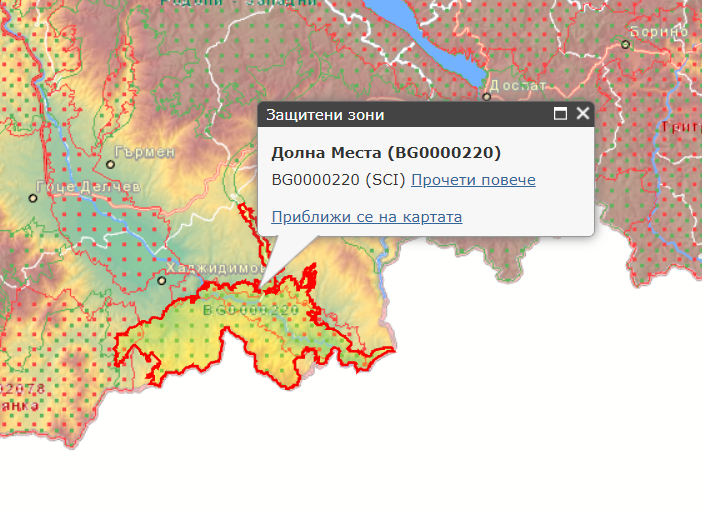
Dolna Mesta Protected Area - BG0000220
Protected area under Directive 92/43 / EEC for the protection of natural habitats and of wild fauna and flora.
Conservation objectives
Conservation of the area of natural habitats and habitats of species and their populations subject to protection within the protected area.
Preservation of the natural state of the natural habitats and the habitats of the species subject to protection within the protected area, including the natural species composition, characteristic species and environmental conditions of these habitats.
Restoration, if necessary, of the area and natural state of priority natural habitats and habitats of species, as well as populations of species subject to protection within the protected area.
Subject of protection
Invertebrates - Beech felling / Morimus funereus /; Rosalia alpina; Hand cancer / Austropotamobius torrentium /; Cerambyx cerdo; Stag beetle / Lucanus cervus / etc.
Fish - Barbus plebejus; European bitters / Rhodeus sericeus amarus /.
Mammals without bats - European wolf / Canis lupus /; Otter / Lutra lutra /; Variegated ferret / Vormela peregusna /.
Bats - Long-eared Nightingale / Myotis bechsteini /; Myotis emarginatus; Myotis myotis; Great Rhinolophus ferrumequinum; Rhinolophus hipposideros, etc.
Natural habitats - 91E0 Alluvial forests with Alnus glutinosa and Fraxinus excelsior(Alno-Pandion, Alnion incanae, Salicion albae); 5210 Shrubs with Juniperus spp .; 6210 Semi-natural dry grass and shrub communities on limestone (Festuco-Brometalia); 9170 Oak-hornbeam forests of the Galio-Carpinetum type, etc.
×
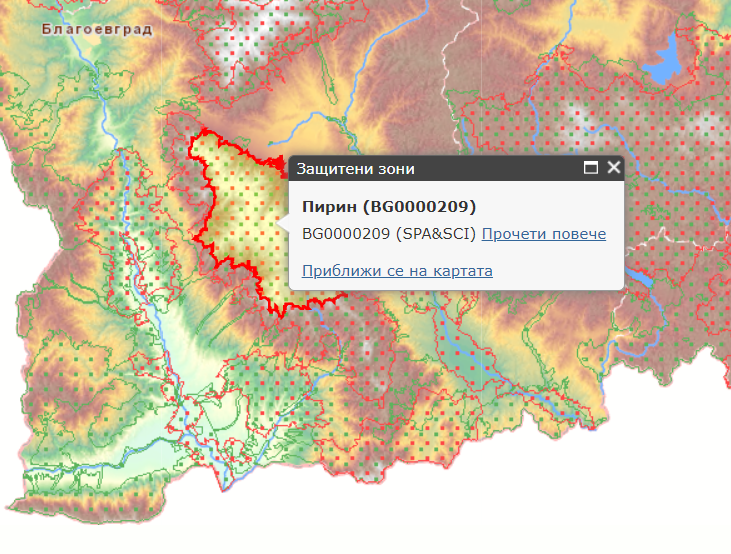
Pirin Protected Area - BG0000209
Protected area under both Directives - Directive 79/409 / EEC on the conservation of wild birds and Directive 92/43 / EEC on the conservation of natural habitats and of wild fauna and flora.
The protected zone falls within the lands of Razlog, Razlog municipality, Bansko town, Dobrinishte town, Obidim village and Kremen village, Bansko municipality, Breznitsa village and Kornitsa village, Gotse Delchev municipality, Pirin village , Lilyanovo village, Gorna Sushitsa village, Sugarevo village and Ploski village, Sandanski municipality, Ilindentsi village, Strumyani municipality, Stara Kresna village and Brezhani village, Simitli municipality, Blagoevgrad district.
Conservation objectives
Conservation of the area of natural habitats and habitats of species and their populations subject to protection within the protected area.
Preservation of the natural state of the natural habitats and the habitats of the species subject to protection within the protected area, including the natural species composition, characteristic species and environmental conditions of these habitats.
Restoration, if necessary, of the area and natural state of priority natural habitats and habitats of species, as well as populations of species subject to protection within the protected area.
Amphibians and reptiles - Bombina variegata; Thorn tortoise / Testudo graeca /; The Spiky Turtle / Testudo hermanni /.
Mammals without bats - European wolf / Canis lupus /; Otter / Lutra lutra /; Wild goat / Rupicapra rupicapra balcanica /; Brown bear / Ursus arctos /.
Bats - Long-eared Nightingale / Myotis bechsteini /; Myotis emarginatus; Myotis myotis; Great Rhinolophus ferrumequinum; Rhinolophus hipposideros, etc.
Birds:
According to Art. 6, para. 1, item 3 of the BDA: 38 species of birds are subject to protection, some of which are - Caprimulgus europaeus; Bubo bubo; Small bald eagle / Aquila pomarina /; Egyptian Vulture / Neophron percnopterus /; Black stork / Ciconia nigra /; Eagle snake / Circaetus gallicus /; Pernis apivorus; White stork / Ciconia ciconia /; White-tailed buzzard (Buteo rufinus) and others
According to Art. 6, para. 1, item 4 of the BDA: Yellow-legged Gull / Larus cachinnans /; Blackthorn (Falco tinnunculus); Orco / Falco subbuteo /; Buteo buteo; Actitis hypoleuco; Little Hawk / Accipiter nisus /; Merops apiaster; Charadrius dubius.
Natural habitats - 3260 Plain or mountain rivers with vegetation of Ranunculion fluitantis and Callitricho-Batrachion; 6170 Alpine and subalpine limestone grass communities; 9110Luzulo-Fagetum beech forests; 8210 Hazmophytic vegetation on limestone rock slopes, etc.
×
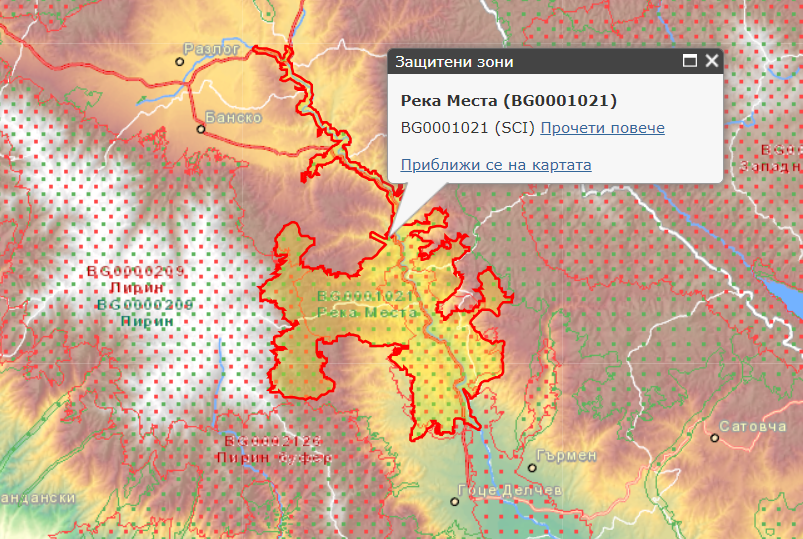
Protected area River Mesta - BG0001021
Protected area under Directive 92/43 / EEC for the protection of natural habitats and of wild fauna and flora.
The protected zone falls within the lands of the town of Bansko, the village of Gostun, the town of Dobrinishte, the village of Kremen, the village of Mesta, the village of Obidim, the village of Osenovo, the village of Filipovo, the municipality of Bansko, the district of Blagoevgrad, the village of Gorno Kraishte, Belitsa municipality, Blagoevgrad district, Banichan village, Breznitsa village, Bukovo village, Gospodintsi village, Kornitsa village, Luzhnitsa village, Gotse Delchev municipality, Blagoevgrad district, Baldevo village, Osikovo village, Ribnovo village , Skrebatno village, Garmen municipality, Blagoevgrad district, Banya village, Eleshnitsa village, Razlog municipality, Blagoevgrad district.
Conservation objectives
Conservation of the area of natural habitats and habitats of species and their populations subject to protection within the protected area.
Preservation of the natural state of the natural habitats and the habitats of the species subject to protection within the protected area, including the natural species composition, characteristic species and environmental conditions of these habitats.
Restoration, if necessary, of the area and natural state of priority natural habitats and habitats of species, as well as populations of species subject to protection within the protected area.
Mammals without bats - European wolf / Canis lupus /; Otter / Lutra lutra /; Wild goat / Rupicapra rupicapra balcanica /; Brown bear / Ursus arctos /; Variegated ferret / Vormela peregusna /.
Bats - Myotis myotis; Rhinolophus hipposideros; Great Rhinolophus ferrumequinum; Barbastella barbastellus; Myotis bechsteini, etc.
Natural habitats - 91E0 Alluvial forests with Alnus glutinosa and Fraxinus excelsior(Alno-Pandion, Alnion incanae, Salicion albae); 3260 Plain or mountain rivers with vegetation of Ranunculion fluitantis and Callitricho-Batrachion; 9110Luzulo-Fagetum beech forests; 91CA Rila-Rhodope and Stara Planina white pine forests.
Within the protected area is prohibited:
Car racing off-road and designated off-road races;
Movement of motorcycles, ATVs, UTVs and buggies off existing roads in non-urban areas; the prohibition does not apply to the routes for the movement of the listed motor vehicles determined on the basis of a normative act, as well as in case of disasters, emergencies and for carrying out fire-fighting, emergency, control and rescue activities;
Search and study of common minerals (construction and rock facing materials), discovery of new and expansion of concession areas for extraction of common minerals (construction and rock facing materials) in the territories occupied by natural habitats under item 2.1; the prohibition does not apply in cases where, as of the date of promulgation of the order in the State Gazette, a procedure has been initiated for granting permits for prospecting and / or exploration, and / or for granting a mining concession under the Mineral Resources Act and The Concessions Act, or a procedure for their coordination has been initiated under Chapter Six of the Environmental Protection Act and / or Art. 31 of the BDA, or an application for registration of a commercial discovery has been submitted;
Changing the way of permanent use, plowing, afforestation and conversion into permanent crops of meadows, pastures and measures for the use of agricultural land as such;
Plowing and afforestation of meadows, barren lands and other unforested forest territories within the boundaries of non-mountain natural habitats under item 2.1 except in cases of proven need for protection against erosion and floods, as well as in cases of implementation of eligible plans, programs, projects or investment proposals approved in accordance with environmental legislation;
Elimination of landscape features (borders, living single and groups of trees, traditional strips occupied by shrubbery among arable land, protective forest belts, stone fences and hedges) in the use of agricultural land as such except in cases the removal of invasive alien species of trees and shrubs;
Use of fertilizers, soil improvers, biologically active substances, nutrient substrates and plant protection products that do not meet the requirements of the Plant Protection Act;
Use of mineral fertilizers in meadows, pastures, meadows and abandoned arable lands, as well as plant protection products and biocides of professional category of use in these areas, except for calamity, epiphytosis, epizootic, epidemic or in the application of selective methods for combating invasive alien species;
Use of organic sludge from industrial and other waters and household waste for introduction into agricultural lands without permission from the specialized bodies of the Ministry of Agriculture, Food and Forestry and when the concentration of heavy metals, metalloids and persistent organic pollutants in sludge exceeds background concentrations according to Annex № 1 of Ordinance № 3 of 2008 on the norms for permissible content of harmful substances in soils (SG, issue 71 of 2008);
Use of irrigation water that contains harmful substances and waste above the permissible norms;
Burning of stubble, syllables, roadside strips and areas with dry and moisture-loving vegetation;
Burning fires, landscaping, electrification, economic and sports activities in undeveloped caves and their entrances, as well as breaking, damaging, collecting or moving rock and cave formations, blocking the entrances or their individual galleries in a way , preventing the passage of the species of bats subject to protection under item 2.2.1;
Conducting speleological research during the breeding season of bats - from March 1 to June 30;
Drainage of coastal floodplains, changes in the hydromorphological regime through drainage, removal of alluvial deposits, correction, dam construction of rivers, except for those: in urban areas; in cases of danger of floods, which may endanger human life and health or cause material damage; in case of disasters and accidents; to improve the condition of the natural habitats and the habitats of the species under item 2;
Carrying out felling in natural habitats with codes 91E0 * and 91D0 * except for the needs of facilities (elements) of the technical infrastructure, for prevention of dangers endangering human life and health, in case of disasters and accidents, for maintenance / improvement of the natural habitats and the habitats of the species under item 2, as well as in the cases of realization of admissible investment proposals, approved by the order of the ecological legislation;
Extraction of wood and biomass in old age forests, except in cases of damage of more than 50% of the area of the respective old age forest due to natural disasters and calamities; in the old-age forests through which existing forest roads and other infrastructure sites pass, if proven necessary, felling of single dry, damaged, endangered or obstructing the safe movement of people and vehicles or the normal functioning of infrastructure sites trees is allowed. ;
Grazing of domestic animals in forest areas, which are designated for forests in the old age phase;
Construction of new roads of second and higher class without ensuring the construction of appropriate green infrastructure for the passage of bears and other animals.
×
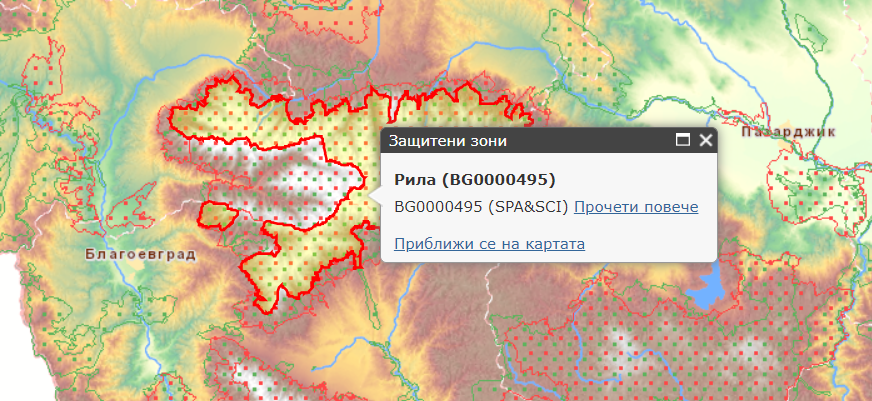
Rila Protected Area - BG0000495
Protected area under both Directives - Directive 79/409 / EEC on the conservation of wild birds and Directive 92/43 / EEC on the conservation of natural habitats and of wild fauna and flora.
Conservation objectives
Conservation of the area of natural habitats and habitats of species and their populations subject to protection within the protected area.
Preservation of the natural state of the natural habitats and the habitats of the species subject to protection within the protected area, including the natural species composition, characteristic species and environmental conditions of these habitats.
Restoration, if necessary, of the area and natural state of priority natural habitats and habitats of species, as well as populations of species subject to protection within the protected area.
Amphibians and reptiles - Bombina variegata; Thorn tortoise / Testudo graeca /; Testudo hermanni; Southern Crested Newt (Triturus karelinii).
Mammals without bats - European wolf / Canis lupus /; Otter / Lutra lutra /; Wild goat / Rupicapra rupicapra balcanica /; Spermophilus citellus; Brown bear / Ursus arctos /.
Bats - Long-eared Nightingale / Myotis bechsteini /; Myotis emarginatus; Myotis myotis; Great Rhinolophus ferrumequinum; Rhinolophus hipposideros, etc.
Birds:
According to Art. 6, para. 1, item 3 of the BDA: Goat / Caprimulgus europaeus /; Black stork / Ciconia nigra /; Pernis apivorus; Eagle snake / Circaetus gallicus /; Rock Eagle / Aquila chrysaetos /; Bubo bubo; Black woodpecker / Dryocopus martius /; Dalmatian Falcon / Falco biarmicus /; Capercaillie / Tetrao urogallus / and others
According to Art. 6, para. 1, item 4 of the BDA: Little Hawk / Accipiter nisus /; Blackthorn (Falco tinnunculus); Orco / Falco subbuteo /; Great Hawk / Accipiter gentilis /; Buteo buteo; Charadrius dubius; Actitis hypoleucos.
Natural habitats - 3260 Plain or mountain rivers with vegetation of Ranunculion fluitantis and Callitricho-Batrachion; 4060 Alpine and boreal ericoid communities; 6520 Mountain hay meadows; 9110Luzulo-Fagetum beech forests.
×
Protected area Rila Monastery - BG0000496
Protected area under both Directives - Directive 79/409 / EEC on the conservation of wild birds and Directive 92/43 / EEC on the conservation of natural habitats and of wild fauna and flora.
The protected zone falls within the lands of the village of Padala, the village of Pastra and the village of Rila Monastery, Rila Municipality, Kyustendil District.
Conservation objectives
Conservation of the area of natural habitats and habitats of species and their populations subject to protection within the protected area.
Preservation of the natural state of the natural habitats and the habitats of the species subject to protection within the protected area, including the natural species composition, characteristic species and environmental conditions of these habitats.
Restoration, if necessary, of the area and natural state of priority natural habitats and habitats of species, as well as populations of species subject to protection within the protected area.
Mammals without bats - European wolf / Canis lupus /; Otter / Lutra lutra /; Wild goat / Rupicapra rupicapra balcanica /; Brown bear / Ursus arctos /.
Bats - Long-eared Nightingale / Myotis bechsteini /; Myotis emarginatus; Myotis myotis; Great Rhinolophus ferrumequinum; Rhinolophus hipposideros, etc.
Birds:
According to Art. 6, para. 1, item 3 of the BDA: Dalmatian Falcon / Falco biarmicus /; Little Eagle / Hieraaetus pennatus /; Eagle snake / Circaetus gallicus /; Pernis apivorus; Black stork / Ciconia nigra /; Cross (Imperial) Eagle / Aquila heliaca /; Caprimulgus europaeus; Rock Eagle Aquila chrysaetos; Great Spotted Eagle / Aquila clanga /; Small bald eagle / Aquila pomarina /; Black Vulture / Aegypius monachus / etc.
According to Art. 6, para. 1, item 4 of the BDA: Orco / Falco subbuteo /; Great Hawk / Accipiter gentilis /; Charadrius dubius; Buteo buteo; Actitis hypoleucos; Little Hawk / Accipiter nisus /; Falco tinnunculus.
Plant species - Gladiolus palustris.
Natural habitats - 91E0 Alluvial forests with Alnus glutinosa and Fraxinus excelsior (Alno-Pandion, Alnion incanae, Salicion albae); 3130 Oligotrophic to mesotrophic stagnant waters with vegetation of Littorelletea uniflorae and / or Isoeto-Nanojuncetea; 3260 Plain or mountain rivers with vegetation of Ranunculion fluitantis and Callitricho-Batrachion; 4070 Shrub communities with Pinus mugo, etc.
Within the protected area is prohibited:
Afforestation of meadows, pastures and meadows and their conversion into arable land and permanent crops;
The use of pesticides and mineral fertilizers in pastures and meadows;
The use of non-selective pesticides in agriculture and forestry;
Mowing the meadows from the periphery to the center with fast-moving equipment before July 15.
×
Protected area Sreden Pirin - Alibotush - BG0001028
Protected area under Directive 92/43 / EEC for the protection of natural habitats and of wild fauna and flora.
The protected area covers the middle and southern part of the Pirin Mountains and the border with Greece Alibotush (Slavyanka). It is a natural continuation of Pirin National Park to the south. The area is very sparsely populated and with very well preserved nature.
Conservation objectives
Conservation of the area of natural habitats and habitats of species and their populations subject to protection within the protected area.
Preservation of the natural state of the natural habitats and the habitats of the species subject to protection within the protected area, including the natural species composition, characteristic species and environmental conditions of these habitats.
Restoration, if necessary, of the area and natural state of priority natural habitats and habitats of species, as well as populations of species subject to protection within the protected area.
Amphibians and reptiles - Bombina variegata; Southern Crested Newt (Triturus karelinii); Testudo hermanni; Thorn tortoise / Testudo graeca /; Emys orbicularis; Elaphe quatuorlineata, etc.
Mats without bats - European wolf / Canis lupus /; Otter / Lutra lutra /; Wild goat / Rupicapra rupicapra balcanica /; Brown bear / Ursus arctos /; Variegated ferret / Vormela peregusna / etc.
Bats - Long-eared Nightingale / Myotis bechsteini /; Myotis emarginatus; Myotis myotis; Great Rhinolophus ferrumequinum; Rhinolophus hipposideros, etc.
Natural habitats - 9130 Beech forests of the type / Asperulo-Fagetum /; 91CA Rila-Rhodope and Stara Planina pine forests; 6220 Pseudo-steppes with cereals and annuals of the class Thero-Brachypodietea; 9170 Oak-hornbeam forests of the Galio-Carpinetum type, etc.
Within the protected area is prohibited:
Car racing off-road and designated off-road races;
Movement of motorcycles, ATVs, UTVs and buggies off existing roads in non-urban areas; the prohibition does not apply to the routes for the movement of the listed motor vehicles determined on the basis of a normative act, as well as in case of disasters, emergencies and for carrying out fire-fighting, emergency, control and rescue activities;
Search and study of common minerals (construction and rock facing materials), discovery of new and expansion of concession areas for extraction of common minerals (construction and rock facing materials) in the territories occupied by natural habitats under item 2.1; the prohibition does not apply in cases where, as of the date of promulgation of the order in the State Gazette, a procedure has been initiated for granting permits for prospecting and / or exploration, and / or for granting a mining concession under the Mineral Resources Act and The Concessions Act, or a procedure for their coordination has been initiated under Chapter Six of the Environmental Protection Act and / or Art. 31 of the BDA, or an application for registration of a commercial discovery has been submitted;
Changing the way of permanent use, plowing, afforestation and conversion into permanent crops of meadows, pastures and measures for the use of agricultural land as such;
Plowing and afforestation of meadows, barren lands and other unforested forest territories within the boundaries of non-mountain natural habitats under item 2.1 except in cases of proven need for protection against erosion and floods, as well as in cases of implementation of eligible plans, programs, projects or investment proposals approved in accordance with environmental legislation;
Elimination of landscape features (borders, living single and groups of trees, traditional strips occupied by shrubbery among arable land, protective forest belts, stone fences and hedges) in the use of agricultural land as such, except in cases of removal of invasive alien species of trees and shrubs;
Use of fertilizers, soil improvers, biologically active substances, nutrient substrates and plant protection products that do not meet the requirements of the Plant Protection Act;
Use of mineral fertilizers in meadows, pastures, meadows and abandoned arable lands, as well as plant protection products and biocides of professional category of use in these areas, except for calamity, epiphytosis, epizootic, epidemic or in the application of selective methods for combating invasive alien species;
Use of organic sludge from industrial and other waters and household waste for introduction into agricultural lands without permission from the specialized bodies of the Ministry of Agriculture, Food and Forestry and when the concentration of heavy metals, metalloids and persistent organic pollutants in sludge exceeds background concentrations according to Annex № 1 of Ordinance № 3 of 2008 on the norms for permissible content of harmful substances in soils (SG, issue 71 of 2008);
Use of irrigation water that contains harmful substances and waste above the permissible norms;
Burning of stubble, syllables, roadside strips and areas with dry and moisture-loving vegetation;
Burning fires, landscaping, electrification, economic and sports activities in undeveloped caves and their entrances, as well as breaking, damaging, collecting or moving rock and cave formations, blocking the entrances or their individual galleries in a way , preventing the passage of the species of bats subject to protection under item 2.2.1;
Conducting speleological research during the breeding season of bats - from March 1 to June 30;
Grazing of domestic animals in forest areas, which are designated for forests in the old age phase;
Extraction of wood and biomass in old age forests, except in cases of damage of more than 50% of the area of the respective old age forest due to natural disasters and calamities; in the old-age forests through which existing forest roads and other infrastructure sites pass, if proven necessary, felling of single dry, damaged, endangered or obstructing the safe movement of people and vehicles or the normal functioning of infrastructure sites trees is allowed. ;
Construction of new roads of second and higher class without ensuring the construction of appropriate green infrastructure for the passage of bears and other animals.
×
Protected area Yadenitsa - BG0001386
Protected area under Directive 92/43 / EEC for the protection of natural habitats and of wild fauna and flora.
The protected area is located in the Western Rhodopes. To the west it stretches to Yundola and the valley of the Yadenitsa River, which is the orographic border between Rila and the Western Rhodopes, to the south it reaches the Chepino valley, to the east - the western slopes of Karkaria ridge, and to the north to the ridge and parts of the southern slopes. Alabak. The Chepinska River and part of its left and right tributaries flow through the protected area.
The zone is located in part of the lands of the municipalities of Septemvri, Belovo, Velingrad and Rakitovo.
Conservation objectives
Conservation of the area of natural habitats and habitats of species and their populations subject to protection within the protected area.
Preservation of the natural state of the natural habitats and the habitats of the species subject to protection within the protected area, including the natural species composition, characteristic species and environmental conditions of these habitats.
Restoration, if necessary, of the area and natural state of priority natural habitats and habitats of species, as well as populations of species subject to protection within the protected area.
Mammals without bats - European wolf / Canis lupus /; Otter / Lutra lutra /; Brown bear / Ursus arctos /.
Bats - Long-eared Nightingale / Myotis bechsteini /;Myotis emarginatus; Myotis myotis; Great Rhinolophus ferrumequinum; Rhinolophus hipposideros, etc.
Natural habitats - 9170 Oak-hornbeam forests of Galio-Carpinetum type; 9130Asperulo-Fagetum beech forests; 91CA Rila-Rhodope and Stara Planina pine forests; 91BA Moesian fir forests, etc.
Within the protected area is prohibited:
Conducting off-road racing
Movement of motorcycles, ATVs, UTVs and buggies off existing roads in non-urban areas; the prohibition does not apply to the routes for movement of the listed motor vehicles determined on the basis of a normative act, as well as in case of disasters, emergencies and for carrying out fire-fighting, emergency, control and rescue activities;
Search and study of common minerals (construction and rock facing materials), discovery of new and expansion of concession areas for extraction of common minerals (construction and rock facing materials) in the territories occupied by natural habitats under item 2.1; the prohibition does not apply in cases where, as of the date of promulgation of the order in the State Gazette, a procedure has been initiated for granting permits for prospecting and / or exploration, and / or for granting a mining concession under the Mineral Resources Act and The Concessions Act, or a procedure for their coordination has been initiated under Chapter Six of the Environmental Protection Act and / or Art. 31 of the BDA, or an application for registration of a commercial discovery has been submitted;
Changing the way of permanent use, plowing, afforestation and conversion into permanent crops of meadows, pastures and measures for the use of agricultural land as such;
Plowing and afforestation of meadows, barren lands and other unforested forest territories within the boundaries of non-mountain natural habitats under item 2.1 except in cases of proven need for protection against erosion and floods, as well as in cases of implementation of eligible plans, programs, projects or investment proposals approved in accordance with environmental legislation;
Elimination of landscape features (borders, living single and groups of trees, traditional strips occupied by shrubbery among arable land, protective forest belts, stone fences and hedges) in the use of agricultural land as such except in cases the removal of invasive alien species of trees and shrubs;
Use of fertilizers, soil improvers, biologically active substances, nutrient substrates and plant protection products that do not meet the requirements of the Plant Protection Act;
Use of mineral fertilizers in meadows, pastures, measures, abandoned arable lands and forest areas, as well as plant protection products and biocides of professional category of use in these areas except for calamity, epiphytosis, epizootic, epidemic or application of selective methods for combating invasive alien species;
Use of organic sludge from industrial and other waters and household waste for introduction into agricultural lands without permission from the specialized bodies of the Ministry of Agriculture, Food and Forestry and when the concentration of heavy metals, metalloids and persistent organic pollutants in sludge exceeds background concentrations according to Annex № 1 of Ordinance № 3 of 2008 on the norms for permissible content of harmful substances in soils (SG, issue 71 of 2008);
Use of irrigation water that contains harmful substances and waste above the permissible norms;
Burning of stubble, syllables, roadside strips and areas with dry and moisture-loving vegetation;
Extraction of wood and biomass in old age forests, except in cases of damage of more than 50% of the area of the respective old age forest due to natural disasters and calamities; in the old-age forests through which existing forest roads and other infrastructure sites pass, if proven necessary, felling of single dry, damaged, endangered or obstructing the safe movement of people and vehicles or the normal functioning of infrastructure sites trees is allowed. ;
Grazing of domestic animals in forest areas, which are designated for forests in the old age phase;
Carrying out felling in natural habitat with code 91E0 * except for the needs of facilities (elements) of the technical infrastructure, for prevention of dangers endangering human life and health, in case of disasters and accidents, for maintenance / improvement of natural habitats and the habitats of the species under item 2, as well as in the cases of realization of admissible investment proposals, approved by the order of the ecological legislation;
Construction of new roads of second and higher class without ensuring the construction of appropriate green infrastructure for the passage of bears and other animals.